Managing a school is no longer just about teaching and learning. School administrators today have to handle admissions, attendance, fees, examinations, communication, staff management, student records, reports, and many other daily operations.
When these activities are managed using registers, spreadsheets, paper records, and disconnected tools, things can become difficult as the school grows.
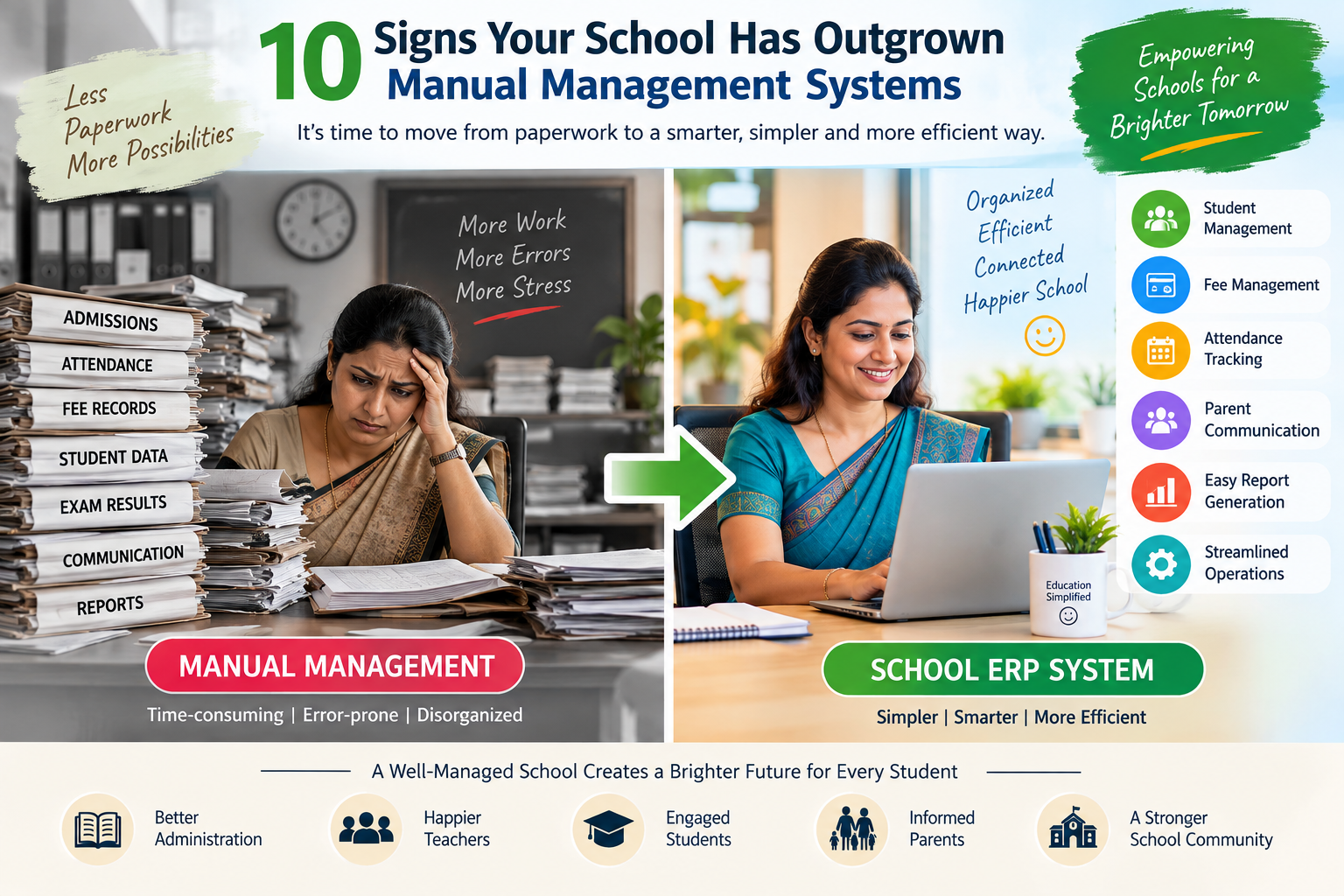
If your school is facing repeated administrative challenges, it may be a sign that you have outgrown manual management systems and need a modern School ERP Software.
In this blog, let's look at the 10 common signs that indicate it may be time to move from manual processes to a centralized school management system.
Table of Contents
- Too Much Time Spent on Administrative Work
- Student Records Are Difficult to Manage
- Fee Collection and Tracking Takes Too Much Effort
- Attendance Management Is Still Mostly Manual
- Communication With Parents Is Not Efficient
- Generating Reports Takes Too Long
- Teachers Are Handling Too Many Administrative Tasks
- Information Is Stored in Multiple Places
- Managing School Operations Becomes Difficult as You Grow
- Important Data Is Difficult to Access Quickly
- Why Schools Should Move to a School ERP System
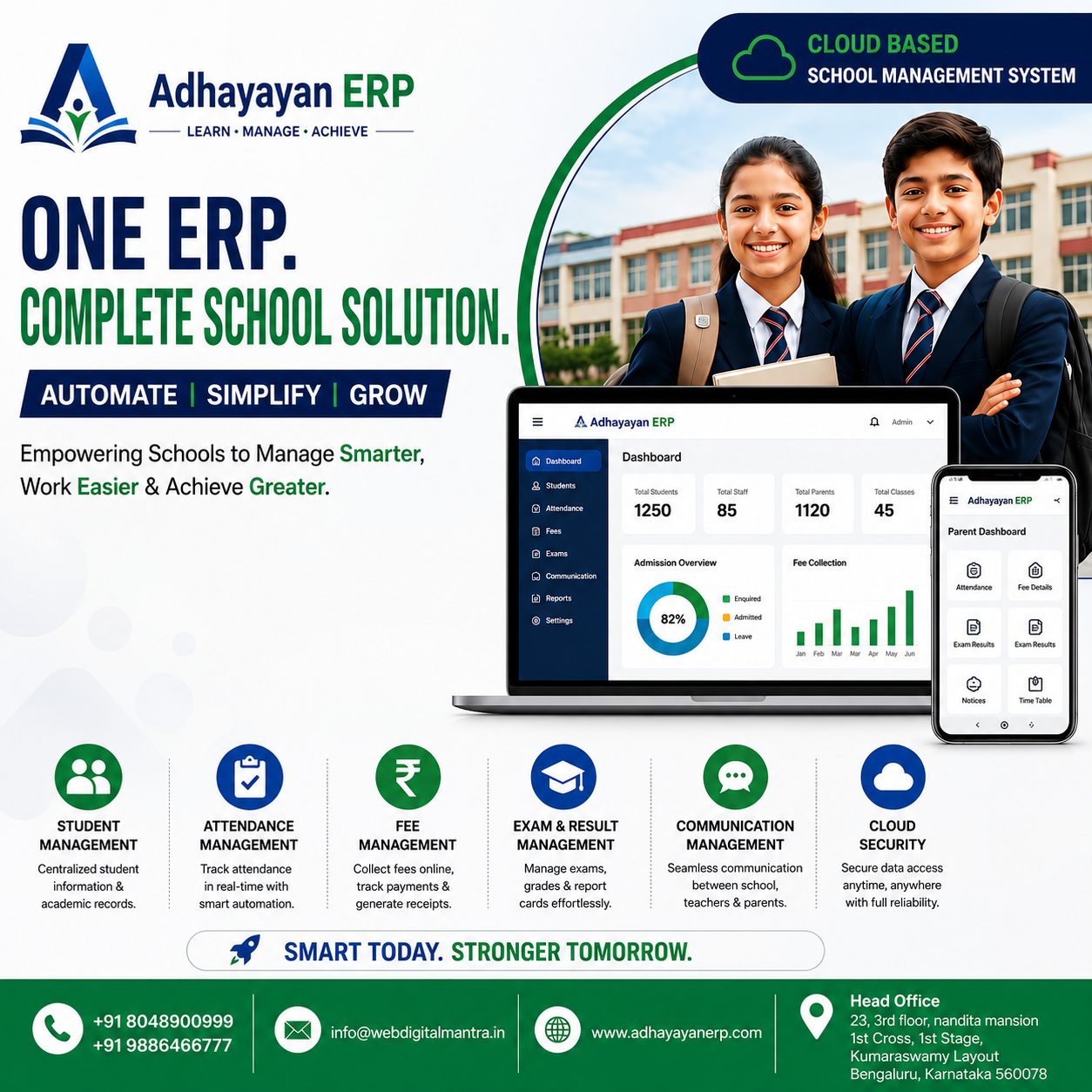
- How Adhayayan ERP Can Help
- Conclusion
- Frequently Asked Questions
1. Too Much Time Is Spent on Administrative Work
One of the biggest signs that your school has outgrown manual management is the amount of time spent on repetitive administrative tasks.
School staff may spend hours every day updating spreadsheets, maintaining registers, entering student information, preparing reports, checking fee records, and searching for documents.
These activities are necessary, but they should not consume most of the staff's working hours.
A modern school management system can automate many routine activities and help administrators spend more time on important school operations.
2. Student Records Are Difficult to Manage
As the number of students increases, maintaining student information manually becomes increasingly complicated.
Schools may need to maintain information such as:
- Student personal details
- Parent and guardian information
- Attendance records
- Academic performance
- Fee details
- Examination results
- Documents
- Previous academic records
When this information is stored across different registers or files, finding the right information can take time.
A centralized School ERP system allows authorized users to manage student information from one platform.
3. Fee Collection and Tracking Takes Too Much Effort
Fee management is another area where manual processes can create unnecessary work.
Schools may have to track:
- Paid fees
- Pending fees
- Due dates
- Discounts
- Receipts
- Student-wise fee history
- Class-wise collections
When these records are maintained manually, errors and delays can occur.
A digital school fee management system can make fee tracking more organized and help administrators quickly identify pending payments and generate reports.
4. Attendance Management Is Still Mostly Manual
Taking attendance is a daily responsibility, but maintaining attendance records manually can become time-consuming.
Teachers may need to maintain registers and later submit attendance information to the administration.
This can make it difficult to quickly identify attendance patterns or prepare consolidated reports.
With a digital school management system, attendance information can be recorded and managed more efficiently, giving administrators better visibility into student attendance.
5. Communication With Parents Is Not Efficient
Parents expect timely information about their children's academic activities and school updates.
If schools depend mainly on printed notices, phone calls, or separate messaging groups, important information can sometimes be missed.
Schools need an organized communication system for sharing:
- Announcements
- Attendance updates
- Fee reminders
- Examination information
- Academic updates
- Events and notices
A modern school ERP software can help schools improve communication between administrators, teachers, students, and parents.
6. Generating Reports Takes Too Long
School administrators regularly need reports for decision-making and daily operations.
For example:
- Attendance reports
- Fee collection reports
- Student performance reports
- Admission reports
- Examination reports
- Staff reports
When data is maintained manually, preparing these reports may require collecting information from different files and registers.
This not only takes time but can also increase the possibility of data-entry mistakes.
A centralized ERP system can make it easier to access organized information and generate useful reports.
7. Teachers Are Handling Too Many Administrative Tasks
Teachers should primarily focus on teaching, mentoring students, and improving learning outcomes.
However, manual processes can require teachers to spend significant time on administrative activities such as maintaining attendance, preparing records, updating student information, and submitting reports.
When these processes are digitized, teachers can reduce repetitive paperwork and focus more on their core responsibilities.
This is one of the major advantages of implementing a school management software.
8. Information Is Stored in Multiple Places
Does your school keep student information in one spreadsheet, fee information in another file, attendance in registers, and examination data somewhere else?
If yes, your school may already be experiencing the limitations of disconnected systems.
When information is scattered across multiple locations, it becomes difficult to maintain consistency.
A centralized School ERP brings different administrative processes together in one digital environment.
This can make information easier to manage and reduce unnecessary duplication.
9. Managing School Operations Becomes Difficult as You Grow
A system that works for a small school may not work effectively when the institution grows.
More students mean:
- More records
- More teachers
- More fees to track
- More attendance data
- More examinations
- More communication
- More administrative responsibilities
If your existing system is becoming difficult to manage as your school expands, it may be time to consider scalable school ERP software.
The right technology can help schools manage increasing amounts of information without increasing paperwork at the same rate.
10. Important Data Is Difficult to Access Quickly
School administrators often need information immediately.
For example, a principal may need to know:
- How many students are absent today?
- Which students have pending fees?
- How are students performing academically?
- How many new admissions have been received?
- What are the latest attendance statistics?
If finding these answers requires checking multiple files or asking different staff members, your school may need a better system.
A centralized school management platform can provide quicker access to important information and support better decision-making.
Why Should Schools Move From Manual Management to ERP?
Manual systems may work when a school is small and has limited administrative requirements.
But as the institution grows, manual processes can lead to:
- Increased paperwork
- Repetitive data entry
- Communication delays
- Difficulty tracking information
- Reporting challenges
- Higher chances of errors
- Increased administrative workload
A School ERP Software can bring these processes together into a centralized digital system.
Instead of managing different operations separately, schools can use one platform to manage important academic and administrative activities.
How Adhayayan ERP Can Help Schools
Adhayayan ERP is designed to help educational institutions manage their operations through a centralized digital platform.
Instead of depending entirely on registers, spreadsheets, and disconnected systems, schools can use ERP technology to organize important processes digitally.
Depending on the school's requirements, an ERP platform can support areas such as:
- Student Management
- Admission Management
- Attendance Management
- Fee Management
- Examination Management
- Academic Management
- Teacher and Staff Management
- Parent Communication
- Reports and Analytics
- School Administration
The biggest advantage is not simply replacing paper with software. It is about creating a more connected and organized way to manage school operations.
Manual School Management vs School ERP
| Manual Management | School ERP |
|---|---|
| Paper-based records | Digital records |
| Multiple files and registers | Centralized information |
| Time-consuming data entry | Automated workflows |
| Difficult report preparation | Faster access to reports |
| Limited information access | Centralized access |
| Higher risk of manual errors | Better data organization |
| Separate communication methods | Integrated communication |
| Difficult to scale | Designed for growing institutions |
When Is the Right Time to Implement a School ERP?
There is no single student count that determines when a school should adopt ERP software.
The right time is when your existing processes start affecting productivity, accuracy, communication, or decision-making.
If your staff spends too much time searching for information, preparing reports, updating records, or managing repetitive tasks, it may be the right time to consider a School ERP system.
Starting early can also make it easier for staff to adapt to digital workflows before administrative complexity increases further.
Benefits of a Modern School Management System
A well-planned school ERP implementation can help schools:
Save Administrative Time
Automating repetitive activities can reduce unnecessary manual work.
Improve Data Organization
Important student and school information can be managed through a centralized system.
Improve Communication
Schools can provide information to parents, teachers, and students more efficiently.
Support Better Decision-Making
Organized data and reports can help administrators understand school operations.
Reduce Paperwork
Digital workflows can reduce dependence on physical registers and documents.
Support School Growth
A scalable ERP system can help schools manage increasing administrative requirements.
Conclusion
If your school is spending too much time on paperwork, struggling to manage student records, finding it difficult to track fees, or taking too long to prepare reports, these may be signs that your school has outgrown manual management systems.
Moving to a modern School ERP Software can help bring important school operations into one organized digital environment.
The goal is not simply to use technology. The goal is to save time, improve organization, reduce repetitive work, and help school administrators make better decisions.
With the right school management system, schools can build a more efficient digital foundation for their growing academic and administrative needs.
Adhayayan ERP can help educational institutions take the next step toward smarter and more organized school management.
Frequently Asked Questions
What is a School ERP?
A School ERP is a digital platform that helps educational institutions manage academic and administrative activities such as student records, attendance, fees, examinations, admissions, communication, and reporting.
Why should schools replace manual management systems?
Manual systems can become difficult to manage as the number of students, teachers, and administrative activities increases. ERP software can centralize information and reduce repetitive administrative work.
Can School ERP reduce paperwork?
Yes. Many school ERP platforms digitize processes that traditionally depend on paper registers, forms, and spreadsheets, helping reduce paperwork and improve record management.
Is School ERP useful for growing schools?
Yes. A scalable ERP system can help schools manage increasing numbers of students, records, staff, transactions, and administrative activities more efficiently.
How does School ERP improve parent communication?
A school ERP can provide organized communication channels for announcements, attendance information, fee reminders, academic updates, and other school-related information.
How can I choose the right School ERP?
Consider factors such as features, ease of use, scalability, data security, support, reporting capabilities, integrations, and the specific requirements of your school before selecting an ERP solution.