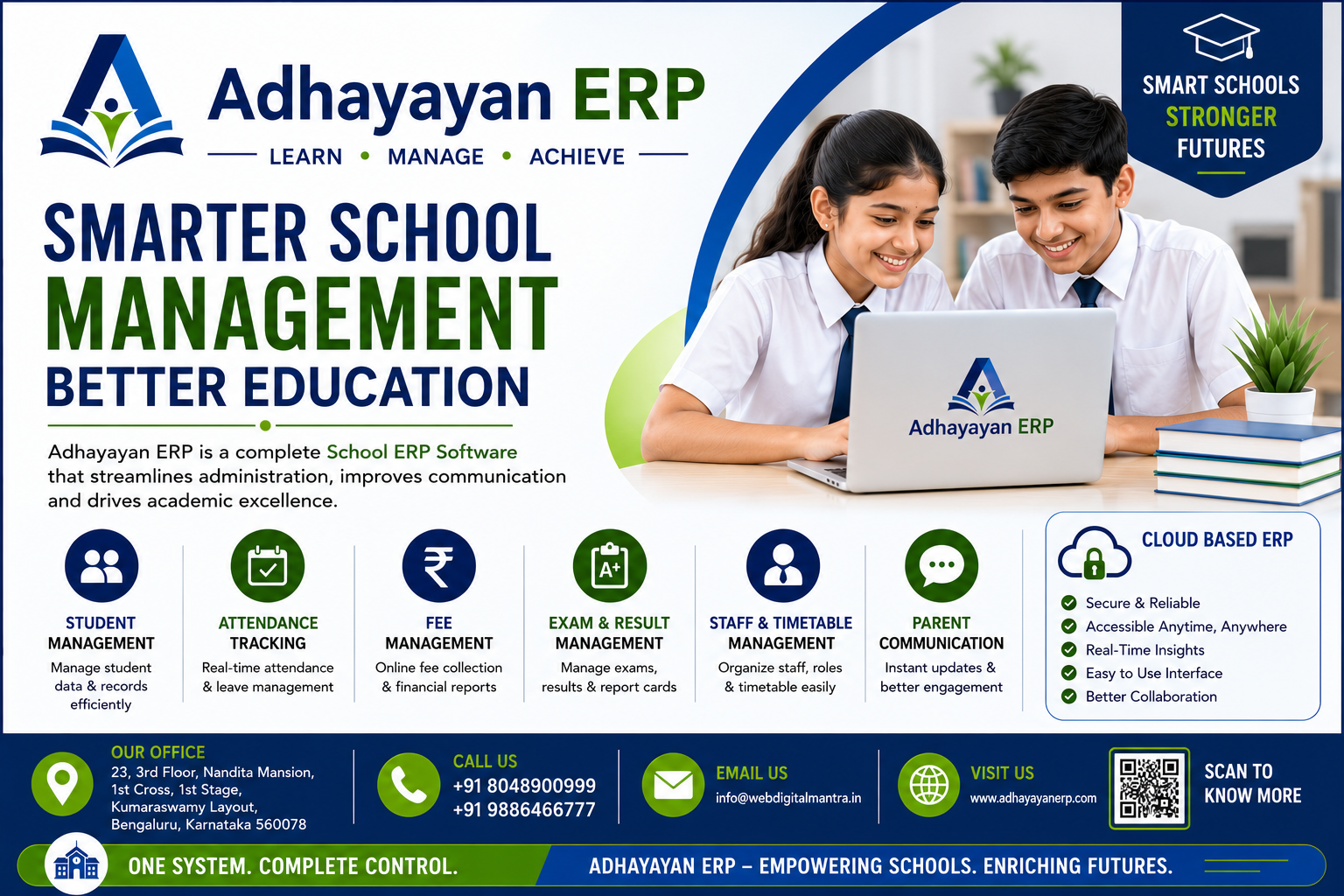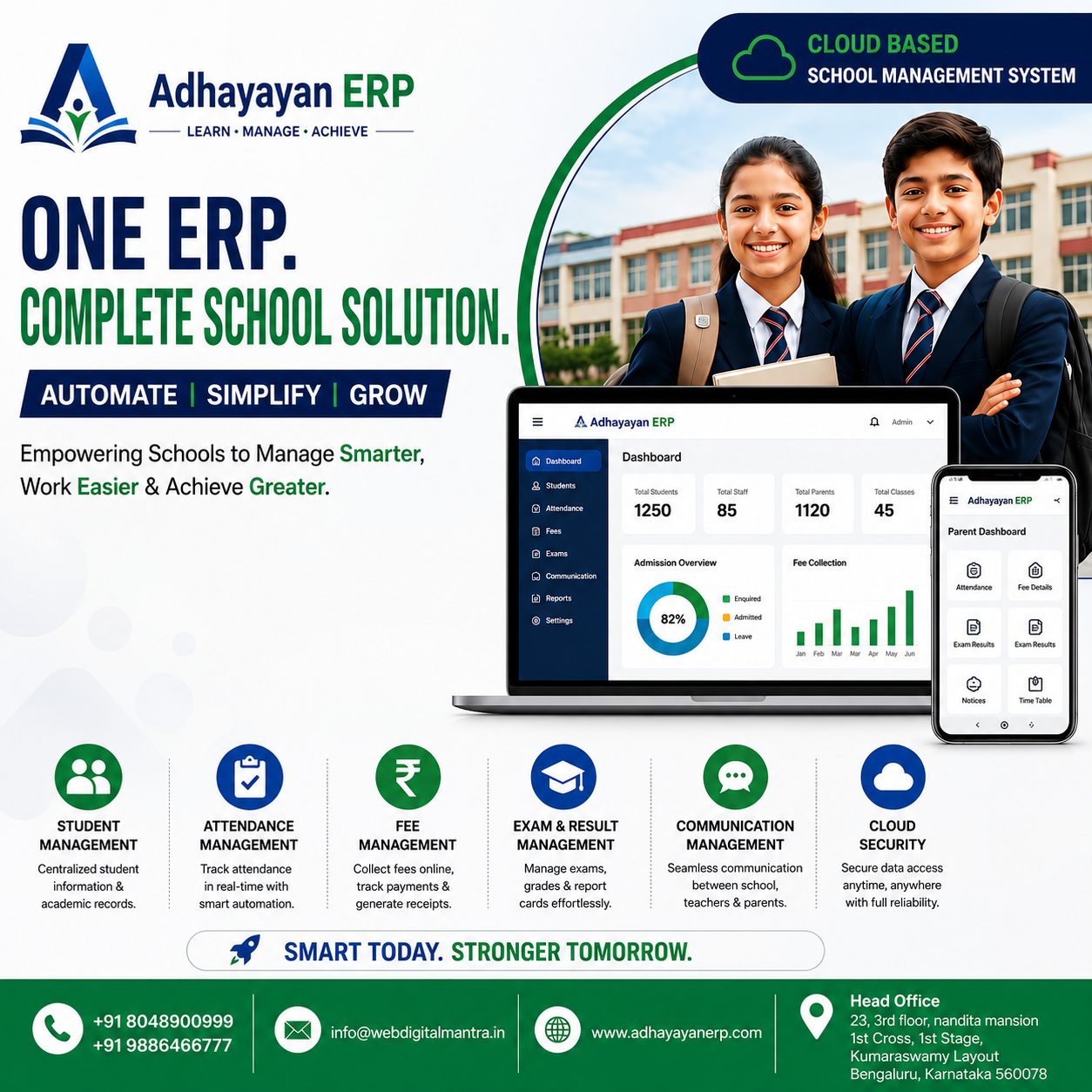
Managing a school or college involves much more than teaching students. From student admissions and attendance to fee collection, examinations, communication, staff management, and reports, educational institutions handle a large amount of information every day.
When these activities are managed manually using registers, spreadsheets, and multiple disconnected applications, administrative work can become time-consuming and difficult to track.
This is where affordable education ERP software for schools and colleges in Bangalore can make a significant difference.
An Education ERP brings important academic and administrative operations together on a single digital platform. It helps institutions organize information, reduce repetitive work, improve communication, and make everyday management more efficient.
For schools and colleges looking for a practical digital solution without a large technology investment, an affordable ERP can be a valuable step toward smarter education management.
Table of Contents
- What Is Education ERP Software?
- Why Do Schools and Colleges in Bangalore Need ERP Software?
- Key Features of Education ERP Software
- Benefits of Affordable Education ERP Software
- Education ERP for Schools
- Education ERP for Colleges
- How ERP Improves Student Management
- How ERP Simplifies Fee Management
- Attendance and Academic Management
- Parent, Student, and Staff Communication
- Reports and Data Management
- Cloud-Based Education ERP Software
- How to Choose an Affordable Education ERP
- Education ERP vs Manual Management
- Why Bangalore Institutions Are Moving Towards ERP
- Cost Considerations
- Frequently Asked Questions
- Conclusion
What Is Education ERP Software?
Education ERP software is a centralized management system designed to help educational institutions manage their academic, administrative, financial, and communication activities digitally.
Instead of maintaining information across separate registers, spreadsheets, and applications, an ERP allows schools and colleges to manage important processes through one integrated platform.
Depending on the solution, an education ERP may include modules such as:
- Student management
- Admission management
- Attendance management
- Fee management
- Examination management
- Timetable management
- Staff management
- Parent communication
- Student communication
- Reports and analytics
- Notifications
- Document management
- Academic management
The goal is simple: reduce administrative complexity and give educational institutions better control over their daily operations.
What Is Education ERP Software?
Education ERP software is a centralized management system designed to help educational institutions manage their academic, administrative, financial, and communication activities digitally.
Instead of maintaining information across separate registers, spreadsheets, and applications, an ERP allows schools and colleges to manage important processes through one integrated platform.
Depending on the solution, an education ERP may include modules such as:
- Student management
- Admission management
- Attendance management
- Fee management
- Examination management
- Timetable management
- Staff management
- Parent communication
- Student communication
- Reports and analytics
- Notifications
- Document management
- Academic management
The goal is simple: reduce administrative complexity and give educational institutions better control over their daily operations.
Why Do Schools and Colleges in Bangalore Need ERP Software?
Bangalore has a large and growing education ecosystem that includes schools, colleges, coaching institutions, professional institutes, and other educational organizations.
As institutions grow, managing student records and administrative activities manually becomes increasingly challenging.
Common problems include:
- Maintaining large amounts of student data
- Tracking daily attendance
- Managing fee payments
- Preparing examination records
- Communicating with parents and students
- Creating administrative reports
- Managing staff information
- Avoiding duplicate data
- Searching for old records
An education ERP can bring these activities together and make information easier to manage.
For institutions with limited budgets, choosing an affordable school ERP or college ERP in Bangalore can provide digital capabilities without unnecessarily increasing operational costs.
Key Features of Education ERP Software
A good Education ERP should provide features that address the actual requirements of an institution.
1. Student Management
Student management is one of the core functions of an education ERP.
Institutions can maintain important student information such as:
- Student profiles
- Contact information
- Parent details
- Academic records
- Admission information
- Class or department details
- Documents
- Attendance records
Having centralized student information makes it easier for authorized staff to find and manage records.
2. Admission Management
Admission processes often involve collecting student information, verifying documents, assigning classes, and maintaining records.
An ERP can help institutions organize these activities digitally.
A structured admission system can help reduce paperwork and make the admission workflow easier for administrators.
3. Attendance Management
Attendance is an important part of academic administration.
Education ERP software can help institutions record and monitor:
- Student attendance
- Staff attendance
- Daily attendance
- Monthly attendance
- Attendance reports
- Absence records
Digital attendance records can also make it easier to identify attendance patterns and generate reports.
4. Fee Management
Managing fees manually can involve considerable administrative work.
A fee management module can help institutions track:
- Fee structures
- Student payments
- Pending fees
- Payment history
- Receipts
- Discounts
- Due dates
- Financial reports
This can make fee administration more organized and reduce the effort involved in maintaining separate records.
5. Examination Management
Schools and colleges regularly conduct tests, internal assessments, semester examinations, and other evaluations.
An ERP can help manage:
- Examination schedules
- Subjects
- Marks
- Grades
- Results
- Student performance
- Examination reports
This helps academic teams maintain examination information in a structured manner.
6. Timetable Management
Creating and maintaining timetables can be complicated, particularly in larger institutions.
ERP software can help administrators organize:
- Class timetables
- Faculty schedules
- Subject allocation
- Room allocation
- Department schedules
A centralized timetable system makes information easier for staff and students to access.
7. Parent and Student Communication
Communication between institutions, students, and parents is an important part of education management.
ERP platforms can support communication through features such as:
- Announcements
- Notifications
- Attendance updates
- Fee reminders
- Academic updates
- Event information
- Important notices
Better communication can help institutions keep stakeholders informed.
Benefits of Affordable Education ERP Software
Choosing an affordable ERP does not mean choosing a system with limited value. The right solution should focus on the features that an institution actually needs.
Major benefits include:
Reduced Administrative Work
Routine tasks can be organized digitally, reducing repetitive manual work.
Major benefits include:
Reduced Administrative Work
Routine tasks can be organized digitally, reducing repetitive manual work.
Centralized Information
Student, staff, academic, and administrative information can be managed from one platform.
Better Accuracy
Digital records can help reduce errors caused by repeated manual data entry.
Faster Reporting
Administrators can access important information and generate reports more efficiently.
Improved Communication
Schools and colleges can communicate important information to students, parents, and staff more effectively.
Improved Communication
Schools and colleges can communicate important information to students, parents, and staff more effectively.
Better Data Accessibility
Authorized users can access required information without searching through multiple registers or files.
Scalability
A suitable ERP can support institutions as student numbers and administrative requirements increase.
Education ERP Software for Schools
Schools have unique requirements, particularly around student attendance, parent communication, fees, examinations, and academic activities.
A school ERP can help manage:
- Student admissions
- Student profiles
- Parent information
- Attendance
- Fees
- Examinations
- Timetables
- Homework or academic activities
- Teacher information
- Notifications
- Reports
For smaller and mid-sized schools, an affordable ERP can provide essential digital management capabilities without requiring complex infrastructure.
Education ERP Software for Colleges
Colleges generally have more complex academic structures involving departments, courses, semesters, faculty members, examinations, and student records.
A college ERP can support areas such as:
- Student admissions
- Department management
- Course management
- Faculty management
- Student attendance
- Semester management
- Examination management
- Fee management
- Academic records
- Reports
- Communication
The right college ERP software in Bangalore should be flexible enough to accommodate the institution's academic structure and administrative workflow.
How ERP Improves Student Management
Student information is often distributed across different departments.
An ERP brings relevant information into a centralized system.
For example, administrators may be able to view a student's:
Admission → Profile → Attendance → Fees → Examination → Academic Records
This creates a more organized approach to student management.
It also reduces the need to maintain multiple independent records for the same student.
How ERP Simplifies Fee Management
Fee collection is one of the areas where educational institutions can benefit significantly from digital management.
Instead of maintaining multiple spreadsheets and registers, institutions can use ERP software to track fee-related information in one place.
Administrators can monitor:
- Paid fees
- Pending fees
- Payment history
- Due dates
- Receipts
- Fee reports
This can make financial administration more transparent and organized.
Attendance and Academic Management
Attendance information can be connected with student records, making it easier for administrators and teachers to monitor attendance.
Academic management can also include information about:
- Classes
- Subjects
- Teachers
- Assessments
- Examination results
- Academic performance
Having these records in a centralized system can support better administrative decision-making.
Parent, Student, and Staff Communication
Educational institutions communicate with multiple groups every day.
An ERP can provide a centralized communication system for:
School/College → Teachers → Students → Parents
Important announcements can be shared through supported communication channels, helping reduce dependence on informal communication methods.
This is particularly useful for schools where parents regularly need information about attendance, fees, examinations, events, and academic activities.
Reports and Data Management
Data becomes increasingly important as an institution grows.
An education ERP can help generate reports related to:
- Student admissions
- Attendance
- Fees
- Examination results
- Academic performance
- Staff information
- Student records
Instead of manually collecting information from different sources, administrators can access organized data through the ERP system.
Cloud-Based Education ERP Software
Cloud-based ERP solutions can be particularly useful for educational institutions that want flexibility and easier access to their management system.
With a cloud-based solution, authorized users may be able to access the platform through internet-connected devices, depending on the provider's setup.
Potential advantages include:
- Easier access
- Centralized data
- Reduced infrastructure requirements
- Easier updates
- Remote accessibility
- Scalable operations
However, institutions should evaluate security, backups, user permissions, data ownership, and vendor support before selecting a cloud-based ERP.
How to Choose Affordable Education ERP Software in Bangalore
Price should not be the only factor when selecting an ERP.
A low-cost solution that does not meet your institution's requirements can become expensive in the long run.
Before choosing an ERP, consider these factors:
1. Required Features
Identify the modules your institution actually needs.
2. Ease of Use
Teachers and administrators should be able to use the system without unnecessary complexity.
3. Scalability
The software should be capable of supporting future growth.
4. Security
Check how the provider handles user access, data security, backups, and permissions.
5. Customer Support
Reliable technical support can be important during implementation and daily usage.
6. Customization
Some institutions may require workflows or modules specific to their operations.
7. Mobile Accessibility
Check whether the platform provides mobile-friendly access or applications where required.
8. Pricing Model
Understand whether pricing is based on students, users, modules, annual subscriptions, implementation, or other factors.
Education ERP vs Manual Management
| Feature | Manual Management | Education ERP |
|---|---|---|
| Student Records | Registers/Spreadsheets | Centralized system |
| Attendance | Manual entries | Digital management |
| Fee Tracking | Registers/Sheets | Organized fee module |
| Examination Records | Manual calculation | Digital records |
| Communication | Multiple channels | Centralized notifications |
| Reports | Time-consuming | Faster access |
| Data Search | Manual | Quick search |
| Scalability | Difficult | Easier to scale |
The exact capabilities depend on the ERP provider and selected modules.
Why Bangalore Institutions Are Moving Towards Digital ERP
Educational institutions are increasingly adopting digital systems because administrative workloads continue to grow.
A well-designed ERP can help institutions move from fragmented record-keeping toward centralized digital management.
For Bangalore schools and colleges, this can be particularly useful when managing:
- Growing student populations
- Multiple departments
- Large administrative teams
- Increasing parent communication
- Academic reporting
- Fee administration
The objective is not simply to digitize paperwork. The bigger goal is to create a more efficient and connected education management process.
How Much Does Education ERP Software Cost?
The cost of education ERP software varies depending on several factors.
Pricing may depend on:
- Number of students
- Number of users
- Modules required
- Customization
- Cloud or on-premise deployment
- Mobile applications
- Implementation requirements
- Technical support
- Data migration
Therefore, institutions should compare the total value and features rather than choosing an ERP based only on the lowest price.
For schools and colleges with limited budgets, a modular or subscription-based ERP can be an option worth evaluating.
What Makes an Education ERP Affordable?
An affordable ERP should provide a balance between price, features, usability, security, and support.
The best option is not necessarily the cheapest software.
Instead, institutions should ask:
"Does this ERP solve our current administrative problems while providing enough flexibility for future growth?"
If the answer is yes, the software can provide better long-term value.
Frequently Asked Questions
What is Education ERP software?
Education ERP software is a centralized platform that helps schools and colleges manage student information, admissions, attendance, fees, examinations, staff, communication, and administrative activities.
Which ERP software is best for schools in Bangalore?
The best school ERP depends on the institution's size, budget, required features, scalability needs, security requirements, and support expectations.
Is Education ERP software affordable for small schools?
Yes. Many ERP providers offer different pricing models and packages. Small schools should compare essential features and choose a plan that matches their actual requirements.
Can colleges use school ERP software?
Some ERP platforms support both schools and colleges, but colleges may require additional features for departments, courses, semesters, faculty, and higher-education examinations.
Does ERP reduce paperwork in schools?
ERP can significantly reduce dependence on paper-based records by digitizing processes such as student management, attendance, fees, examinations, and reporting.
Is cloud-based ERP suitable for educational institutions?
Cloud-based ERP can provide convenient access and reduce the need for local infrastructure, but institutions should carefully evaluate security, backups, privacy, permissions, and vendor reliability.
Can parents access student information?
Depending on the ERP, parent portals or mobile applications may allow parents to access information such as attendance, fees, announcements, and academic updates.
How long does ERP implementation take?
Implementation time depends on the size of the institution, number of modules, customization, data migration, training, and deployment method.
Final Thoughts
Choosing the right affordable education ERP software for schools and colleges in Bangalore can help institutions move toward more organized and efficient management.
From student records and attendance to fees, examinations, communication, and reporting, an integrated ERP can reduce repetitive administrative work and provide better visibility into institutional operations.
However, affordability should always be considered together with functionality, security, scalability, usability, customization, and customer support.
Before making a decision, educational institutions should identify their requirements, compare suitable ERP providers, request a demonstration, understand the pricing structure, and select a platform that can support both current and future needs.
The right Education ERP is not just software—it can become a central part of a smarter education management system.
Ready to Improve Your Institution's Management?
If your school or college in Bangalore is still managing student records, attendance, fees, examinations, and communication through multiple systems, it may be time to explore an integrated Education ERP.
Choose an ERP solution that is affordable, easy to use, scalable, and designed around your institution's requirements.
Request a Demo | Explore Features | Get a Customized Quote