Managing a school involves many daily responsibilities, including admissions, attendance, fee collection, examinations, student records, and communication with parents. Handling these activities manually can take time, create paperwork, and increase the possibility of errors.
A Cloud-Based School ERP Software helps schools manage these processes through one centralized digital platform. It makes school administration more organized, accessible, and efficient while reducing repetitive manual work.
In this blog, let's explore the major benefits of using cloud-based School ERP Software and how it can support modern educational institutions.
Managing a school involves many daily responsibilities, including admissions, attendance, fee collection, examinations, student records, and communication with parents. Handling these activities manually can take time, create paperwork, and increase the possibility of errors.
A Cloud-Based School ERP Software helps schools manage these processes through one centralized digital platform. It makes school administration more organized, accessible, and efficient while reducing repetitive manual work.
In this blog, let's explore the major benefits of using cloud-based School ERP Software and how it can support modern educational institutions.
What Is Cloud-Based School ERP Software?
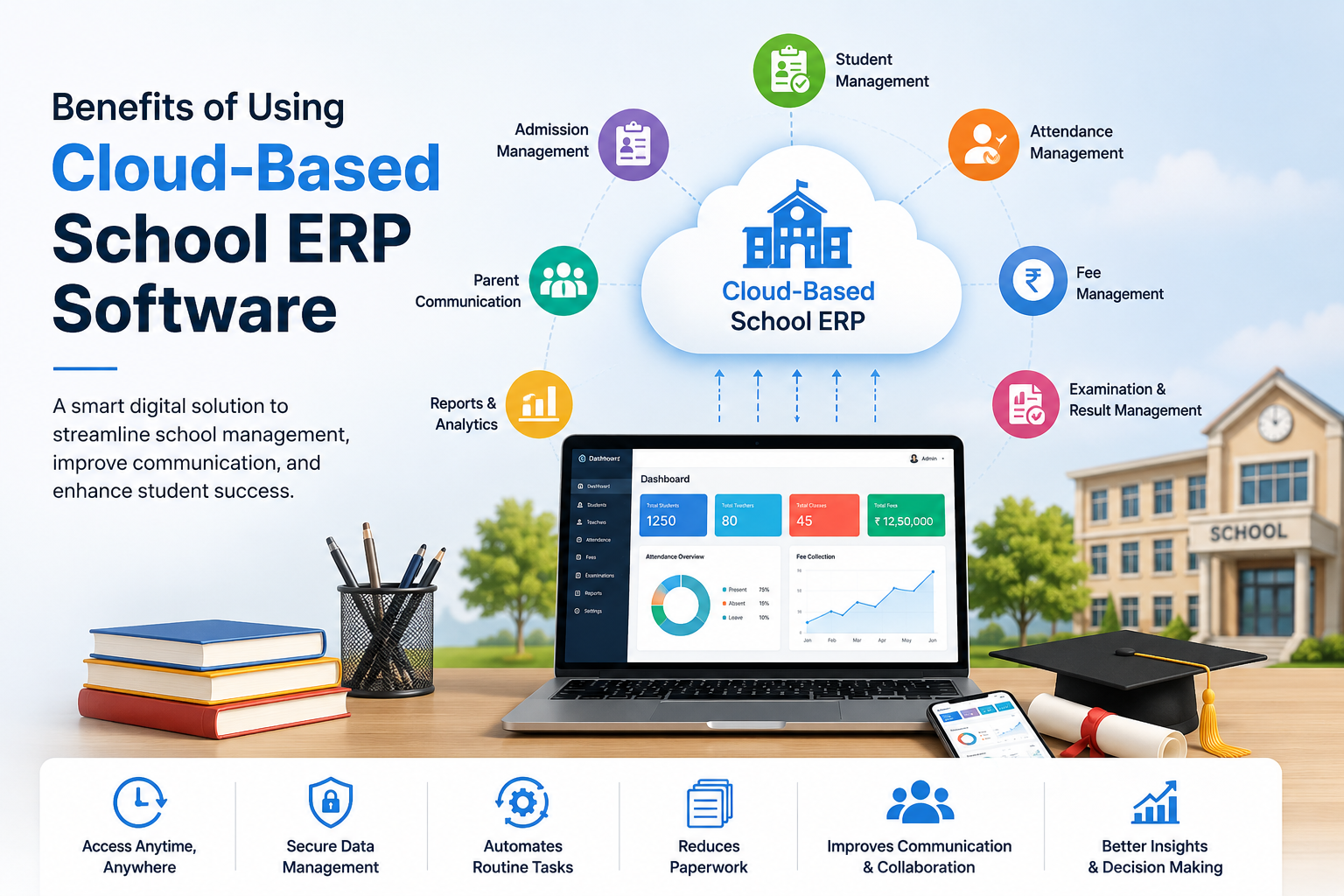
Cloud-based school ERP Software is an online school management system that stores school data securely on cloud infrastructure. Authorized users can access the system through an internet-connected device without depending on software installed on a particular computer.
It can bring multiple school operations together, including:
- Student management
- Admission management
- Attendance management
- Fee management
- Examination management
- Staff management
- Parent communication
- Reports and analytics
- Notifications and announcements
How Does Cloud-Based ERP Work?
Instead of storing all information only on local computers, cloud-based ERP systems store information on remote servers managed by the service provider.
This allows authorized users to access updated information from different locations and devices.
Centralized School Data
All important school information can be managed through a centralized system. This helps administrators and staff find relevant information quickly without searching through multiple registers, files, or spreadsheets.
Role-Based Access
Different users can receive access based on their responsibilities.
For example:
- Administrators can manage overall school operations.
- Teachers can manage attendance and academic information.
- Account staff can manage fees and payments.
- Parents can access relevant student updates.
Secure and Organized Access
Role-based access helps ensure that users only see the information relevant to their responsibilities, supporting better data organization and security.
Benefits of Using Cloud-Based School ERP Software
A cloud-based ERP can provide several benefits for schools, teachers, administrators, students, and parents.
1. Access School Information Anytime, Anywhere
One of the biggest advantages of cloud-based technology is accessibility.
Authorized users can access school information through computers, laptops, tablets, or smartphones with an internet connection.
School administrators can monitor important information even when they are away from their office, while teachers can manage academic and attendance-related activities more conveniently.
What Is Cloud-Based School ERP Software?
Cloud-based school ERP Software is an online school management system that stores school data securely on cloud infrastructure. Authorized users can access the system through an internet-connected device without depending on software installed on a particular computer.
It can bring multiple school operations together, including:
- Student management
- Admission management
- Attendance management
- Fee management
- Examination management
- Staff management
- Parent communication
- Reports and analytics
- Notifications and announcements
How Does Cloud-Based ERP Work?
Instead of storing all information only on local computers, cloud-based ERP systems store information on remote servers managed by the service provider.
This allows authorized users to access updated information from different locations and devices.
Centralized School Data
All important school information can be managed through a centralized system. This helps administrators and staff find relevant information quickly without searching through multiple registers, files, or spreadsheets.
Role-Based Access
Different users can receive access based on their responsibilities.
For example:
- Administrators can manage overall school operations.
- Teachers can manage attendance and academic information.
- Account staff can manage fees and payments.
- Parents can access relevant student updates.
Secure and Organized Access
Role-based access helps ensure that users only see the information relevant to their responsibilities, supporting better data organization and security.
Benefits of Using Cloud-Based School ERP Software
A cloud-based ERP can provide several benefits for schools, teachers, administrators, students, and parents.
1. Access School Information Anytime, Anywhere
One of the biggest advantages of cloud-based technology is accessibility.
Authorized users can access school information through computers, laptops, tablets, or smartphones with an internet connection.
School administrators can monitor important information even when they are away from their office, while teachers can manage academic and attendance-related activities more conveniently.
2. Centralized Student Information
Schools handle a large amount of student information every day.
A School ERP System can bring student details, attendance records, academic information, fee details, and examination results into one centralized platform.
This makes it easier to find, update, and manage student records.
Benefits of Centralized Student Records
- Reduces duplicate records
- Makes information easier to find
- Minimizes paperwork
- Improves data organization
- Simplifies report generation
3. Saves Time and Reduces Manual Work
Manual data entry and repetitive administrative tasks can consume valuable staff time.
A School Management ERP can automate or simplify several routine processes, including attendance calculations, fee reminders, notifications, and report generation.
This allows school staff to spend more time on important educational and administrative responsibilities.
2. Centralized Student Information
Schools handle a large amount of student information every day.
A School ERP System can bring student details, attendance records, academic information, fee details, and examination results into one centralized platform.
This makes it easier to find, update, and manage student records.
Benefits of Centralized Student Records
- Reduces duplicate records
- Makes information easier to find
- Minimizes paperwork
- Improves data organization
- Simplifies report generation
3. Saves Time and Reduces Manual Work
Manual data entry and repetitive administrative tasks can consume valuable staff time.
A School Management ERP can automate or simplify several routine processes, including attendance calculations, fee reminders, notifications, and report generation.
This allows school staff to spend more time on important educational and administrative responsibilities.
4. Simplifies Fee Management
Managing school fees manually can become difficult, especially when dealing with a large number of students.
School ERP Software can help manage fee structures, payment records, receipts, pending fees, and reminders from one platform.
Key Advantages of Digital Fee Management
- Track fee payments
- Monitor pending payments
- Generate receipts
- Maintain payment records
- Send fee reminders
- Reduce paperwork
This creates a more organized and transparent fee management process.
5. Improves Attendance Management
Attendance is an important part of school administration.
Traditional attendance registers require teachers to record and maintain information manually. A digital ERP system can simplify this process by allowing teachers to record attendance through the platform.
The information can then be used to generate attendance reports and provide relevant updates to parents.
6. Simplifies Examination and Result Management
Managing examinations involves several steps, including scheduling exams, entering marks, calculating results, and preparing reports.
A Cloud-Based School ERP can simplify these activities by providing dedicated examination and result management features.
Teachers can enter marks, while administrators can generate reports and review academic performance.
Academic Reports and Insights
Schools can use ERP reports to understand:
- Student performance
- Subject-wise results
- Examination scores
- Attendance patterns
- Academic progress
These insights can support better academic planning and decision-making.
7. Improves Parent-School Communication
Good communication between schools and parents is essential.
A school ERP can provide a centralized communication system for sharing:
- School announcements
- Attendance updates
- Examination information
- Fee reminders
- Important notices
- Academic updates
Parents can stay informed without depending entirely on printed notices or repeated phone calls.
8. Enhances Data Security
4. Simplifies Fee Management
Managing school fees manually can become difficult, especially when dealing with a large number of students.
School ERP Software can help manage fee structures, payment records, receipts, pending fees, and reminders from one platform.
Key Advantages of Digital Fee Management
- Track fee payments
- Monitor pending payments
- Generate receipts
- Maintain payment records
- Send fee reminders
- Reduce paperwork
This creates a more organized and transparent fee management process.
5. Improves Attendance Management
Attendance is an important part of school administration.
Traditional attendance registers require teachers to record and maintain information manually. A digital ERP system can simplify this process by allowing teachers to record attendance through the platform.
The information can then be used to generate attendance reports and provide relevant updates to parents.
6. Simplifies Examination and Result Management
Managing examinations involves several steps, including scheduling exams, entering marks, calculating results, and preparing reports.
A Cloud-Based School ERP can simplify these activities by providing dedicated examination and result management features.
Teachers can enter marks, while administrators can generate reports and review academic performance.
Academic Reports and Insights
Schools can use ERP reports to understand:
- Student performance
- Subject-wise results
- Examination scores
- Attendance patterns
- Academic progress
These insights can support better academic planning and decision-making.
7. Improves Parent-School Communication
Good communication between schools and parents is essential.
A school ERP can provide a centralized communication system for sharing:
- School announcements
- Attendance updates
- Examination information
- Fee reminders
- Important notices
- Academic updates
Parents can stay informed without depending entirely on printed notices or repeated phone calls.
8. Enhances Data Security
Schools manage important information about students, parents, teachers, and staff. Protecting this information is therefore an important responsibility.
Cloud-based ERP systems may include features such as:
- User authentication
- Role-based permissions
- Data backups
- Access controls
- Secure data storage
Schools should always evaluate the security features, policies, and infrastructure of an ERP provider before choosing a solution.
9. Reduces Paperwork
Traditional school administration can involve a large amount of paperwork.
Admissions, attendance, fee receipts, examination records, notices, and reports can all be managed digitally through an ERP platform.
This can help schools reduce paper usage while making records easier to organize and retrieve.
10. Supports Better Decision-Making
School administrators need accurate information to make effective decisions.
A School ERP Software can provide dashboards, reports, and analytics that bring important school information together.
Administrators can use this information to monitor areas such as:
- Student attendance
- Fee collection
- Academic performance
- Admissions
- School operations
This supports more informed and data-driven decision-making.
11. Supports Growing Schools
As a school grows, the number of students, teachers, classes, and administrative activities also increases.
A cloud-based ERP can provide a scalable platform that can adapt to changing school requirements.
This makes it a practical solution for schools planning long-term digital growth.
12. Reduces IT Maintenance
Traditional software may require installation, updates, hardware maintenance, and technical support.
With a cloud-based ERP, much of the technical infrastructure is managed by the service provider.
Schools can therefore focus more on using the system rather than managing complex IT infrastructure.
Who Can Benefit From Cloud-Based School ERP Software?
Cloud-based ERP solutions can benefit different members of an educational institution.
School Administrators
Administrators can manage admissions, student records, fees, attendance, examinations, reports, and other school operations from one platform.
Teachers
Teachers can manage attendance, marks, academic information, and communication more efficiently.
Parents
Parents can receive important updates and access relevant information about their children.
Students
Students can benefit from easier access to academic information, examination results, schedules, and other relevant updates, depending on the ERP features available.
What Should Schools Consider Before Choosing an ERP?
Before selecting a Cloud-Based School ERP Software, school management should consider several factors.
Important Features to Check
- Ease of use
- Mobile accessibility
- Data security
- User permissions
- Reporting and analytics
- Customer support
- Scalability
- Backup and recovery
- Regular software updates
- Integration capabilities
The best ERP solution is not necessarily the one with the most features. It should be easy to use and should match the school's actual requirements.
How Cloud ERP Supports Digital Transformation in Schools
Digital transformation is changing how educational institutions manage their daily operations.
A Cloud-Based School ERP can connect different school activities through one centralized platform.
Instead of managing admissions, attendance, fees, examinations, and communication separately, schools can manage these functions digitally from one system.
This can create a more connected, efficient, and technology-driven school environment.
Why Choose Adhayayan ERP?
Schools manage important information about students, parents, teachers, and staff. Protecting this information is therefore an important responsibility.
Cloud-based ERP systems may include features such as:
- User authentication
- Role-based permissions
- Data backups
- Access controls
- Secure data storage
Schools should always evaluate the security features, policies, and infrastructure of an ERP provider before choosing a solution.
9. Reduces Paperwork
Traditional school administration can involve a large amount of paperwork.
Admissions, attendance, fee receipts, examination records, notices, and reports can all be managed digitally through an ERP platform.
This can help schools reduce paper usage while making records easier to organize and retrieve.
10. Supports Better Decision-Making
School administrators need accurate information to make effective decisions.
A School ERP Software can provide dashboards, reports, and analytics that bring important school information together.
Administrators can use this information to monitor areas such as:
- Student attendance
- Fee collection
- Academic performance
- Admissions
- School operations
This supports more informed and data-driven decision-making.
11. Supports Growing Schools
As a school grows, the number of students, teachers, classes, and administrative activities also increases.
A cloud-based ERP can provide a scalable platform that can adapt to changing school requirements.
This makes it a practical solution for schools planning long-term digital growth.
12. Reduces IT Maintenance
Traditional software may require installation, updates, hardware maintenance, and technical support.
With a cloud-based ERP, much of the technical infrastructure is managed by the service provider.
Schools can therefore focus more on using the system rather than managing complex IT infrastructure.
Who Can Benefit From Cloud-Based School ERP Software?
Cloud-based ERP solutions can benefit different members of an educational institution.
School Administrators
Administrators can manage admissions, student records, fees, attendance, examinations, reports, and other school operations from one platform.
Teachers
Teachers can manage attendance, marks, academic information, and communication more efficiently.
Parents
Parents can receive important updates and access relevant information about their children.
Students
Students can benefit from easier access to academic information, examination results, schedules, and other relevant updates, depending on the ERP features available.
What Should Schools Consider Before Choosing an ERP?
Before selecting a Cloud-Based School ERP Software, school management should consider several factors.
Important Features to Check
- Ease of use
- Mobile accessibility
- Data security
- User permissions
- Reporting and analytics
- Customer support
- Scalability
- Backup and recovery
- Regular software updates
- Integration capabilities
The best ERP solution is not necessarily the one with the most features. It should be easy to use and should match the school's actual requirements.
How Cloud ERP Supports Digital Transformation in Schools
Digital transformation is changing how educational institutions manage their daily operations.
A Cloud-Based School ERP can connect different school activities through one centralized platform.
Instead of managing admissions, attendance, fees, examinations, and communication separately, schools can manage these functions digitally from one system.
This can create a more connected, efficient, and technology-driven school environment
Why Choose Adhayayan ERP?
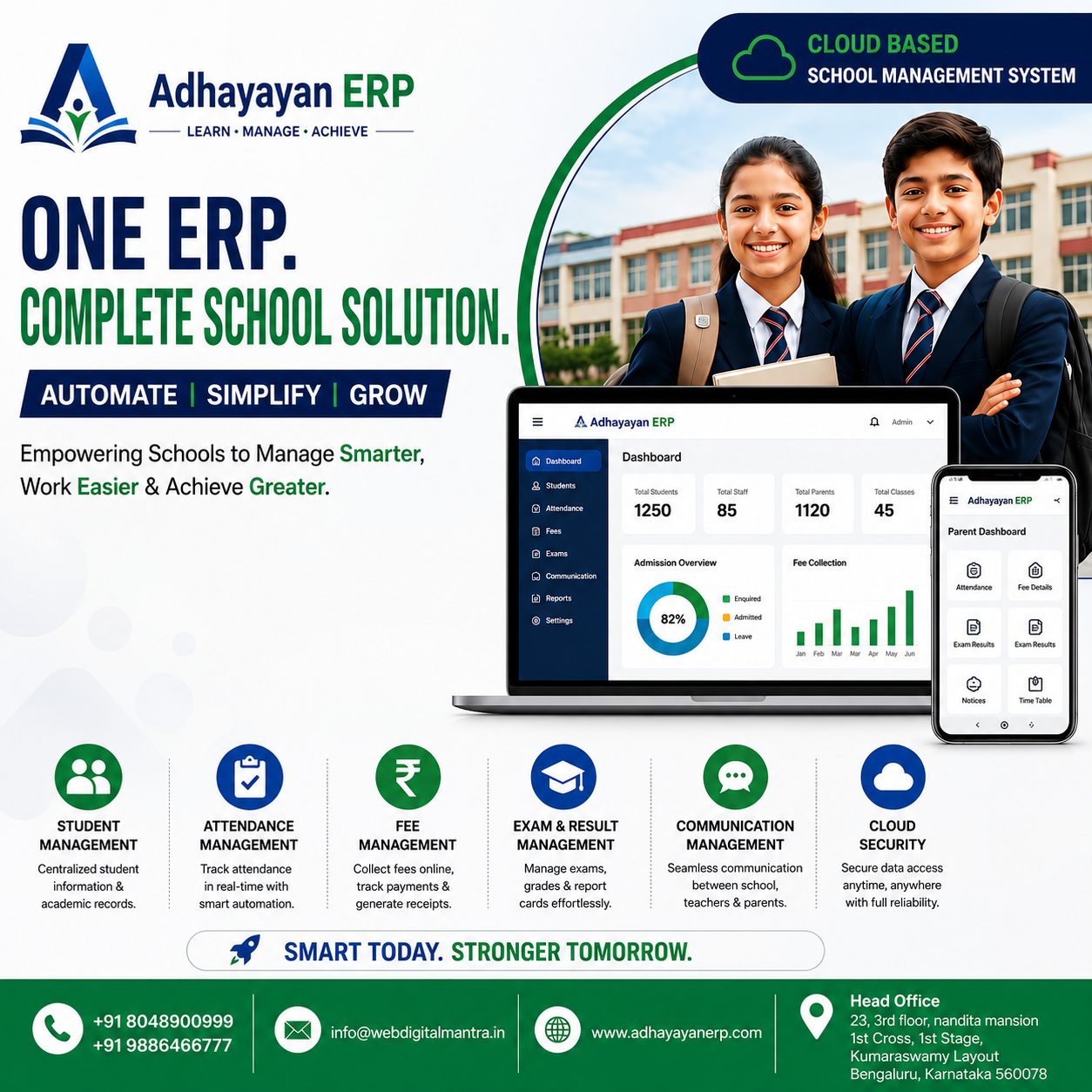
Adhayayan ERP is a cloud-based School ERP Software designed to simplify school management.
It brings essential functions such as:
- Admissions
- Attendance
- Fee management
- Examination management
- Student records
- Parent communication
into one centralized platform.
By reducing manual processes and organizing school information digitally, Adhayayan ERP can help educational institutions improve efficiency and move toward smarter school management.
Adhayayan ERP is a cloud-based School ERP Software designed to simplify school management.
It brings essential functions such as:
- Admissions
- Attendance
- Fee management
- Examination management
- Student records
- Parent communication
into one centralized platform.
By reducing manual processes and organizing school information digitally, Adhayayan ERP can help educational institutions improve efficiency and move toward smarter school management.
Managing a modern school requires efficient processes, accurate information, and effective communication.
A Cloud-Based School ERP Software can help schools simplify daily administration, reduce paperwork, improve accessibility, and organize important information in one place.
From admissions and attendance to fee management, examinations, student records, and parent communication, an ERP system can make school management more efficient.
As educational institutions continue adopting digital technologies, choosing the right Education ERP Software can be an important step toward creating a smarter, more connected, and efficient school management system.
Managing a modern school requires efficient processes, accurate information, and effective communication.
Cloud-based school ERP Software can help schools simplify daily administration, reduce paperwork, improve accessibility, and organize important information in one place.
From admissions and attendance to fee management, examinations, student records, and parent communication, an ERP system can make school management more efficient.
As educational institutions continue adopting digital technologies, choosing the right Education ERP Software can be an important step toward creating a smarter, more connected, and efficient school management system.