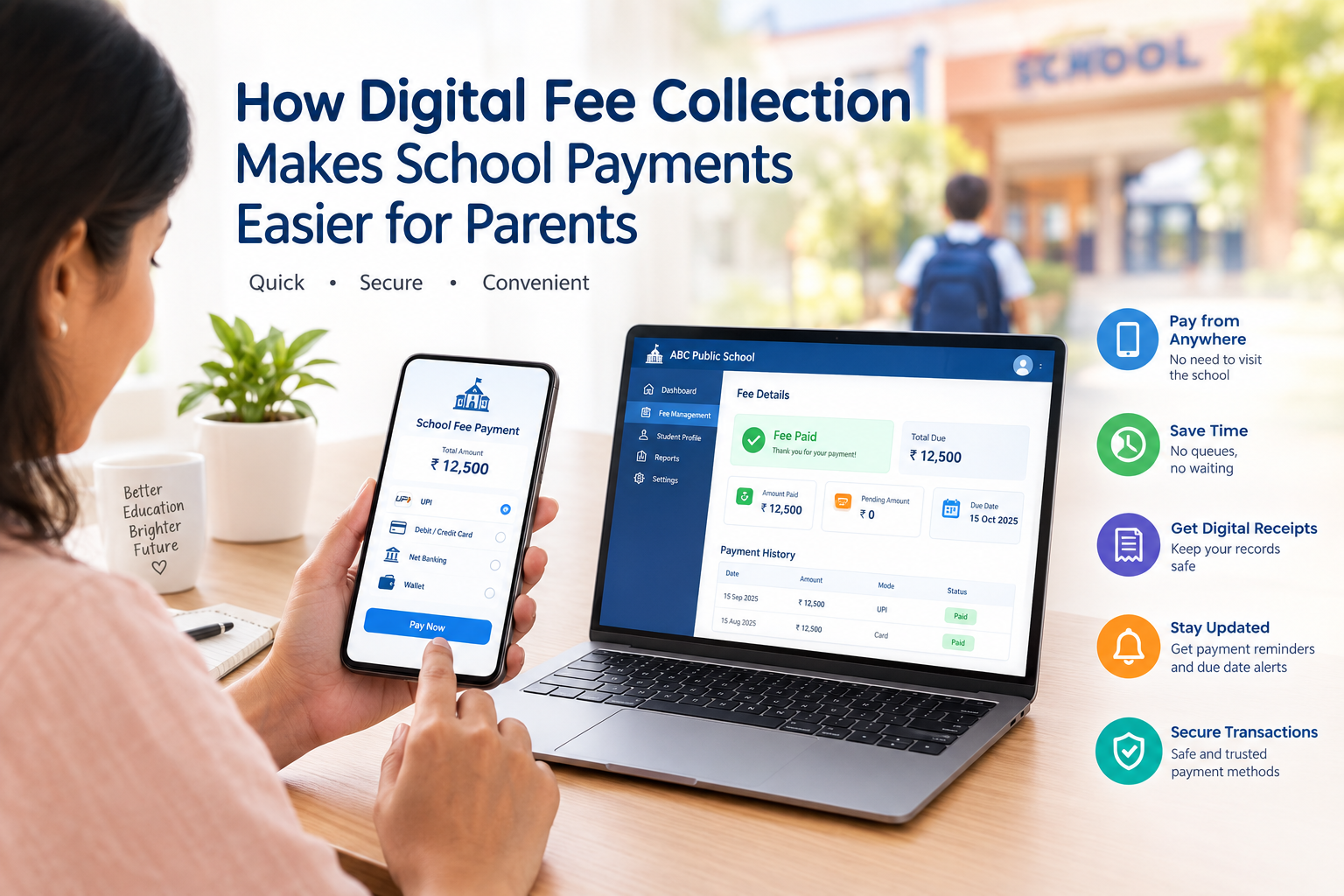
Paying school fees should be simple, convenient, and transparent for parents. However, traditional fee collection methods can sometimes require parents to visit the school, wait in queues, keep track of payment dates, and maintain physical receipts.
Digital fee collection is changing the way schools manage payments. With an online school fee payment system, parents can pay fees securely from their smartphones or computers without needing to visit the school for every transaction.
For schools, digital fee collection also helps simplify fee management, reduce manual work, improve payment tracking, and provide parents with instant payment records.
In this blog, let's understand how digital fee collection makes school payments easier for parents and how schools can benefit from adopting a modern fee management system.
Table of Contents
- What Is Digital Fee Collection?
- Why Traditional School Fee Collection Can Be Difficult
- How Digital Fee Collection Helps Parents
- Key Benefits of Online School Fee Payment
- How Digital Fee Collection Benefits Schools
- Important Features of a School Fee Management System
- Improving Transparency in School Payments
- How Digital Payments Improve the Parent Experience
- Tips for Schools Implementing Digital Fee Collection
- Conclusion
- Frequently Asked Questions
1. What Is Digital Fee Collection?
Digital fee collection is the process of collecting school fees through online payment systems instead of relying entirely on cash, cheques, or physical payment counters.
Using school fee management software, schools can allow parents to view outstanding fees, select payment options, complete transactions online, and receive digital receipts.
Depending on the system, parents may be able to make payments using options such as:
- UPI
- Debit and credit cards
- Net banking
- Mobile banking
- Other supported digital payment methods
This creates a more convenient payment experience for both parents and schools.
2. Why Traditional School Fee Collection Can Be Difficult
Traditional fee collection processes can involve several manual steps.
Parents may need to:
- Visit the school during working hours
- Wait at the fee counter
- Carry cash or payment documents
- Keep physical receipts safely
- Contact the school to confirm payment status
- Remember fee due dates manually
For schools, managing these transactions manually can also increase administrative workload.
Staff may have to update payment records, reconcile transactions, generate receipts, and follow up with parents regarding pending fees.
Digital fee collection helps reduce many of these challenges by bringing the payment process into one centralized system.
3. How Digital Fee Collection Helps Parents
3.1 Pay Fees From Anywhere
One of the biggest advantages of online school fee payment is convenience.
Parents don't necessarily need to visit the school to pay regular fees. They can make payments from home, work, or while travelling, provided they have internet access and the school system supports online payments.
3.2 Save Time
Digital payments can reduce the time spent travelling to school and waiting in queues.
Parents can complete the payment process within a few steps instead of depending on school counter timings.
3.3 Easy Access to Fee Information
A digital fee management system can allow parents to check:
- Total fees
- Amount already paid
- Pending amount
- Due dates
- Payment history
- Receipts
Having this information available digitally makes it easier for parents to stay organized.
3.4 Instant Digital Receipts
After a successful payment, parents can receive a digital receipt depending on the school's system.
This eliminates the need to depend entirely on paper receipts and makes it easier to keep payment records for future reference.
3.5 Convenient Payment Reminders
A school ERP system can help schools communicate important payment information through notifications or reminders.
Parents can receive reminders about upcoming or pending payments, helping them avoid accidentally missing deadlines.
4. Key Benefits of Online School Fee Payment
Digital fee collection can provide several benefits for parents.
| Benefit | How It Helps Parents |
|---|---|
| Online payments | Pay without visiting the school |
| Digital receipts | Easily maintain payment records |
| Payment history | Track previous transactions |
| Fee visibility | Check pending and paid amounts |
| Reminders | Stay aware of upcoming due dates |
| Multiple payment options | Choose a convenient payment method |
| Faster confirmation | Get payment status more conveniently |
The overall goal is to make school fee payments simple, accessible, and transparent.
5. How Digital Fee Collection Benefits Schools
The advantages are not limited to parents. Schools can also improve their administrative processes.
Reduced Manual Work
Automated fee collection reduces the need for staff to manually record every payment.
Better Payment Tracking
Schools can maintain centralized records of payments, pending fees, and transactions.
Easier Reconciliation
Digital transaction records can make it easier for finance teams to compare collected fees with payment records.
Improved Communication
Schools can communicate payment reminders and fee-related information more efficiently.
Better Record Management
Digital records can reduce dependence on physical documents and make historical payment information easier to access.
6. Important Features of a School Fee Management System
When selecting school fee management software, schools should look for features that simplify the experience for both parents and administrators.
Important features may include:
Online Fee Payment
Parents should be able to pay fees through a secure online payment interface.
Fee Structure Management
Schools should be able to configure different fee categories, classes, terms, or other applicable structures.
Payment Tracking
Administrators should be able to monitor successful, pending, and outstanding payments.
Digital Receipts
The system should provide accessible payment receipts after successful transactions.
Automated Reminders
Notifications can help parents stay informed about upcoming or overdue payments.
Payment History
Parents and authorized school staff should be able to view relevant transaction history.
Reports
Schools can use reports to understand fee collection and outstanding amounts.
7. Improving Transparency in School Payments
Transparency is an important part of the parent-school relationship.
When parents can clearly see how much they need to pay, what they have already paid, and whether any amount remains outstanding, there is less confusion around fee transactions.
A digital system can provide a centralized view of payment information, helping parents and schools maintain clearer records.
8. How Digital Payments Improve the Parent Experience
Parents today use digital services for many everyday activities, including shopping, banking, bill payments, and bookings.
School payments can provide a similarly convenient digital experience.
Instead of depending completely on physical payment processes, parents can potentially:
Check → Pay → Receive Confirmation → Access Receipt
This simple workflow can save time and make fee management easier for busy families.
9. Tips for Schools Implementing Digital Fee Collection
Before introducing a digital payment system, schools should consider the following:
Choose a User-Friendly System
The payment process should be simple enough for parents with different levels of technical experience.
Provide Multiple Payment Options
Offering supported digital payment methods can make payments more convenient.
Prioritize Security
Schools should select systems that use appropriate security measures and trusted payment infrastructure.
Communicate Clearly
Parents should receive clear instructions about how to access and use the payment system.
Provide Support
Schools should have a support process for handling payment-related questions or failed transactions.
10. Conclusion
Digital fee collection is making school payments more convenient for modern parents. By allowing parents to check fees, make online payments, receive digital receipts, and track payment information, schools can create a smoother payment experience.
At the same time, schools can reduce manual administrative work, improve payment tracking, and maintain better digital records.
As schools continue adopting school ERP and fee management software, digital fee collection can become an important part of creating a more connected and efficient school management experience.
Frequently Asked Questions
1. What is digital fee collection in schools?
Digital fee collection is a system that allows schools to collect fees through online payment methods instead of relying only on cash, cheques, or physical payment counters.
2. Can parents pay school fees online?
Yes. If the school provides an online fee payment facility, parents can pay through supported digital payment methods without visiting the school.
3. What are the benefits of online school fee payment?
Online school fee payment can save time, provide convenient payment access, simplify record keeping, and make it easier for parents to track their payment history.
4. What is school fee management software?
School fee management software helps educational institutions manage fee structures, payments, receipts, outstanding fees, reminders, and related financial records digitally.
5. How does digital fee collection help schools?
It can reduce manual data entry, improve payment tracking, simplify record management, and help schools communicate fee-related information more efficiently.
6. Is digital fee collection useful for parents?
Yes. It can make fee payments more convenient by allowing parents to access payment information and complete transactions digitally, depending on the school's system.