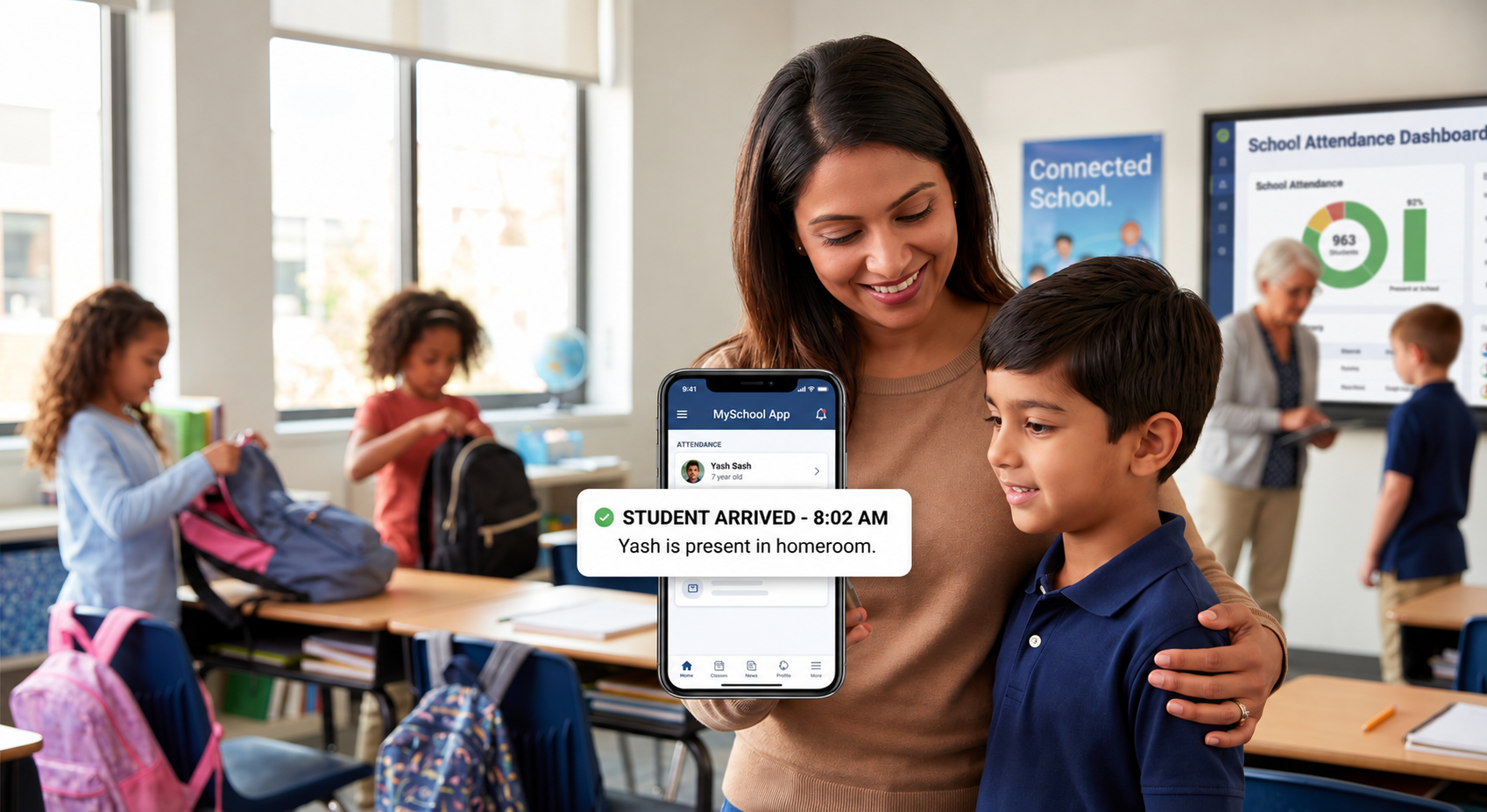
Start with a relatable situation:
Parents send their children to school every morning, but once the child leaves home, parents may not know whether they have actually reached school. Traditional attendance systems can create a communication gap because parents may receive attendance information much later.
Explain how real-time attendance alerts can close this gap by notifying parents when their child is marked present or absent.
The Problem With Traditional Attendance Systems
Discuss common challenges:
- Manual attendance takes time
- Parents may not receive attendance information immediately
- Schools depend heavily on manual communication
- Absence follow-up can be delayed
- Attendance records may be difficult to track
- Communication between parents and schools can become fragmented
What Are Real-Time Attendance Alerts?
Explain the concept in simple language.
A real-time attendance alert system automatically sends attendance-related notifications to parents when a student's attendance status is recorded.
For example:
Student arrives at school → Attendance recorded → Parent receives notification
Mention that depending on the school's system, alerts may be delivered through an app notification, SMS, WhatsApp, email, or another configured communication channel.
How Real-Time Attendance Alerts Improve Student Safety
1. Parents Know When Attendance Is Recorded
Parents can receive timely information instead of waiting until the end of the school day.
2. Faster Response to Unexpected Absences
If a student is unexpectedly marked absent, parents can contact the child or school sooner.
3. Better Parent-School Communication
Automated notifications reduce the need for parents to repeatedly contact the school for basic attendance information.
4. Early Identification of Attendance Issues
Repeated absences or irregular attendance can become easier to identify.
5. Better Accountability
Digital attendance records create a clearer trail of attendance information for authorized school staff and parents.
How Attendance Alerts Build Parent Trust
Explain that trust is not created by notifications alone. It comes from consistent, timely, and transparent communication.
Cover these points:
- Parents receive information on time
- Schools demonstrate greater transparency
- Attendance information is easier to access
- Parents feel more connected to their child's school experience
- Schools can respond more efficiently to attendance concerns
Real-Time Attendance vs Manual Attendance
You can include a simple comparison:
| Manual Attendance | Real-Time Attendance |
|---|---|
| Attendance recorded manually | Attendance recorded digitally |
| Communication may be delayed | Notifications can be sent promptly |
| More administrative work | More automation |
| Difficult to monitor remotely | Easier for authorized users to monitor |
| Follow-up can take longer | Faster absence follow-up |
How Schools Can Use Attendance Alerts Effectively
Include practical recommendations:
- Configure appropriate parent notifications
- Keep student information accurate
- Train teachers and administrative staff
- Define procedures for correcting attendance errors
- Protect student and parent data
- Use attendance reports to identify patterns
- Maintain clear communication with parents
Why Attendance Management Is Becoming Part of Modern School ERP
Connect the topic to school management software.
Explain how modern school ERP systems can combine:
- Attendance management
- Parent communication
- Student records
- Academic information
- Notifications
- Reports
- Administrative workflows
This positions attendance alerts as part of a larger digital school-management ecosystem rather than as an isolated feature.
Example: A Simple Attendance Alert Journey
7:45 AM → Student reaches school
↓
8:00 AM → Teacher records attendance
↓
8:01 AM → Attendance status is updated in the system
↓
8:02 AM → Parent receives notification
↓
If absent → Parent can contact the school and verify the situation
This makes the benefit easy for readers to understand.
Important Considerations for Student Privacy
Because the topic involves children, include a short section about responsible technology use.
Discuss:
- Secure student data
- Authorized access only
- Appropriate notification settings
- Accurate attendance records
- Clear school policies
- Compliance with applicable privacy requirements
Avoid suggesting that an attendance notification by itself guarantees student safety. It is a communication and monitoring tool, not a complete safety system.
Key Benefits at a Glance
You can summarize the article with:
For Parents
- Timely attendance information
- Better communication
- Faster absence follow-up
- Greater visibility
For Schools
- Reduced manual communication
- Better attendance records
- Improved administrative efficiency
- Easier monitoring
For Students
- Better attendance tracking
- Earlier identification of attendance issues
- Stronger communication between home and school
Conclusion
End with the broader message:
Real-time attendance alerts can help schools create a more transparent connection between parents and the classroom. By providing timely attendance information and enabling faster communication around unexpected absences, schools can strengthen parent engagement while supporting their wider student-safety processes.
The goal is not simply to mark students present or absent. It is to create a connected, responsive, and transparent school environment.