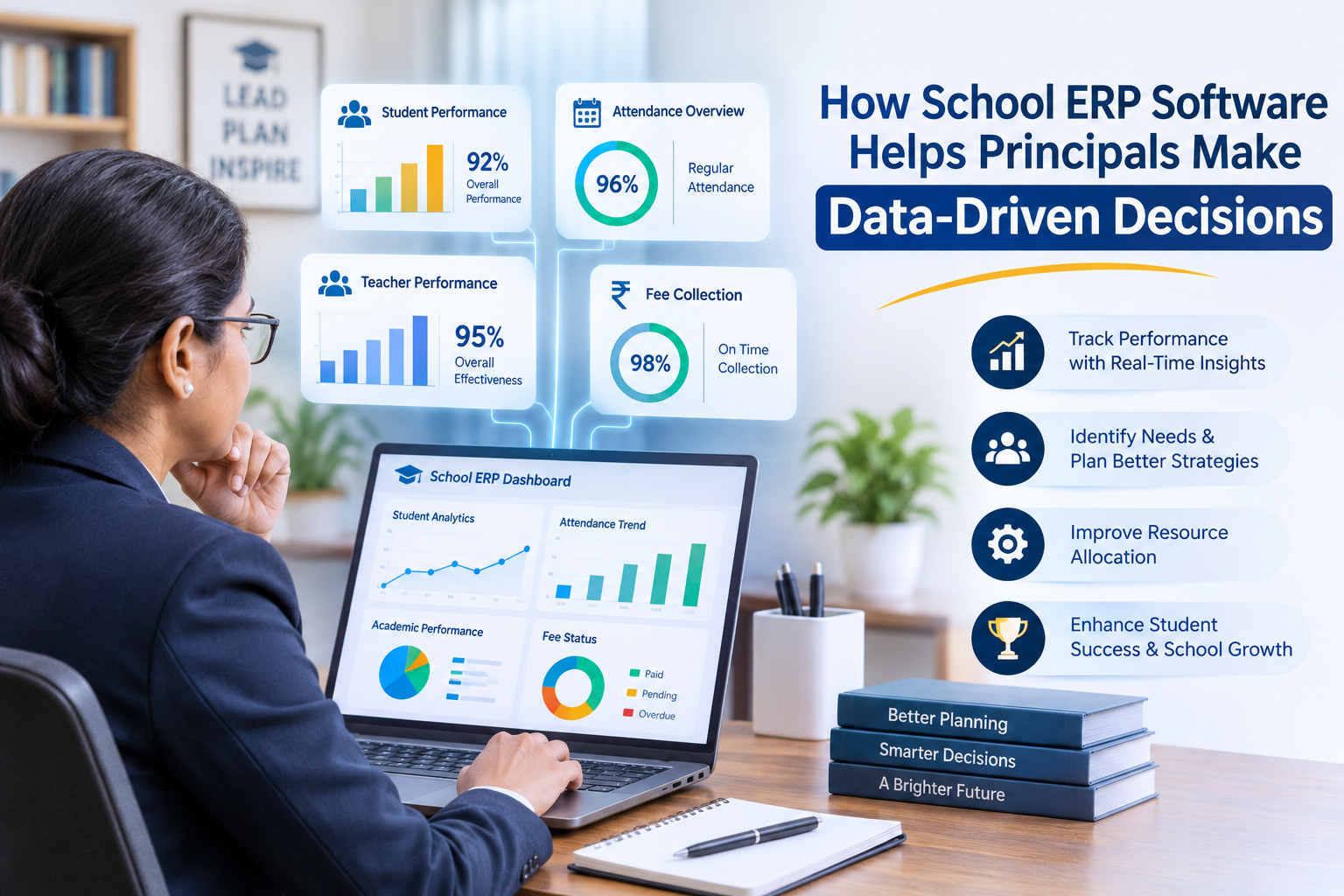
How School ERP Software Helps Principals Make Data-Driven Decisions
Introduction
Running a school involves much more than managing classrooms and academic schedules. Principals must monitor student performance, evaluate teacher effectiveness, manage attendance, oversee fee collection, and ensure that daily operations run smoothly. Making these decisions based only on assumptions, manual records, or occasional reports can be challenging.
This is where School ERP software plays an important role. By bringing essential school information into one centralized platform, a School Enterprise Resource Planning (ERP) system helps principals access accurate, organized, and timely data to make informed decisions.
Instead of spending hours collecting information from different departments, school leaders can use digital dashboards and reports to identify trends, address challenges, and plan improvements. With the right School ERP solution, data becomes a valuable resource for improving academic performance, administrative efficiency, and the overall learning experience.
What Is School ERP Software?
School ERP software is a digital management system that integrates different school operations into one platform. Depending on its features, it can manage student admissions, attendance, examinations, academic records, fee payments, staff information, timetables, parent communication, and other administrative activities.
For principals, the primary benefit is having a consolidated view of school performance. Instead of relying on disconnected spreadsheets, paper registers, or separate departmental reports, they can access relevant information from a central system.
This makes it easier to understand what is happening across the institution and decide what actions are needed.
What Does Data-Driven Decision-Making Mean in Schools?
Data-driven decision-making means using relevant information, measurable results, and identified patterns to guide decisions rather than relying entirely on assumptions or personal judgment.
For example, if a principal notices that student attendance has declined in a particular class, attendance reports can help identify the extent of the problem. The school can then investigate possible causes, communicate with parents, and introduce suitable interventions.
Similarly, examination results can reveal subjects where students need additional support, while financial reports can help administrators plan budgets and manage outstanding fees.
The goal is not simply to collect more data. It is to turn meaningful data into practical action that improves school performance.
10 Ways School ERP Software Helps Principals Make Data-Driven Decisions
1. Monitor Student Academic Performance
Student performance is one of the most important indicators of a school's academic progress. School ERP software helps principals review examination results, subject-wise marks, class performance, and academic progress through organized reports.
By comparing results across examinations and identifying recurring learning gaps, principals can understand where students may need additional support.
For example, if several students perform poorly in mathematics, the principal can work with teachers to review teaching methods, arrange remedial classes, and monitor subsequent progress.
Decision-making benefit: Academic reports help school leaders identify learning challenges early and plan targeted improvement strategies.
2. Track Student Attendance and Identify Patterns
Attendance directly affects classroom participation and learning continuity. Manually reviewing attendance registers across multiple classes can take considerable time.
With School ERP software, principals can access attendance summaries, review class-wise trends, and identify students with frequent absences, depending on the system's reporting capabilities.
These insights allow schools to follow up with parents, investigate attendance concerns, and introduce appropriate support measures.
Decision-making benefit: Attendance data helps principals make timely decisions about student engagement, follow-ups, and attendance improvement initiatives.
3. Evaluate Teacher Performance More Effectively
Supporting teachers is essential for maintaining educational quality. School ERP systems may provide information about attendance, timetable adherence, syllabus progress, assessment schedules, and other measurable teaching-related activities.
When these indicators are reviewed alongside classroom observations and student learning outcomes, principals can identify areas where teachers may benefit from additional resources or professional development.
It is important to use this information fairly. Student marks or a single performance indicator should not be treated as a complete measure of a teacher's effectiveness.
Decision-making benefit: Relevant school data supports constructive teacher feedback, resource planning, and professional development.
4. Improve Administrative Efficiency
School administrators handle admissions, student records, staff details, timetables, examinations, and numerous daily tasks. When these activities are managed through disconnected systems, information can become difficult to retrieve and maintain.
School ERP software centralizes many of these processes, helping principals understand administrative workloads, monitor pending tasks, and identify operational bottlenecks.
For instance, admission reports can help the school review application status, while timetable information can support better coordination between classrooms and staff.
Decision-making benefit: Centralized administrative information helps principals prioritize tasks and allocate resources more effectively.
5. Make Better Financial Decisions
Financial planning is essential for the long-term stability of an educational institution. Principals and school management teams need a clear understanding of fee collection, outstanding payments, operating expenses, and budget requirements.
Depending on the ERP's financial features, reports may show collected fees, pending dues, payment histories, and other financial summaries.
These insights help school leaders plan expenditure, follow up on outstanding payments, and make informed decisions about school resources.
Financial information should be reviewed with appropriate access controls and verified against official accounting records.
Decision-making benefit: Timely financial reports improve visibility into school finances and support more informed budgeting.
6. Strengthen Parent-School Communication
Parents play an important role in student development. However, delayed communication about attendance, academic progress, assignments, or school announcements can make it harder for parents to respond promptly.
School ERP software with parent communication features can provide updates through a parent portal, mobile application, SMS, email, or other supported channels.
For example, when a student frequently misses classes or needs additional academic support, timely communication can help parents and teachers work together to address the issue.
Principals can also review communication processes to identify where information is not reaching parents effectively.
Decision-making benefit: Better communication helps schools coordinate support for students and build stronger relationships with families.
7. Identify Learning Gaps and Plan Academic Improvements
Average marks alone do not always reveal the complete picture of student learning. Principals need to understand subject-level performance, class-wise results, assessment trends, and areas where additional instruction may be necessary.
School ERP reports can help identify patterns that deserve further investigation. For example, consistently low scores in a particular subject may indicate the need to review the syllabus schedule, teaching resources, assessment methods, or student support arrangements.
The principal can work with teachers to introduce remedial sessions, revision plans, or additional learning resources and then evaluate whether the interventions are helping.
Decision-making benefit: Performance trends support targeted academic planning and continuous improvement.
8. Allocate School Resources More Strategically
Schools must distribute resources carefully, including classrooms, teaching staff, learning materials, laboratory facilities, and activity schedules.
When principals have access to reliable enrolment, attendance, timetable, and departmental information, they can make better-informed decisions about where resources are needed most.
For example, class strength and timetable reports may help identify scheduling difficulties or the need to review classroom allocation.
Resource decisions should also consider teacher feedback, student needs, safety requirements, and the school's long-term priorities.
Decision-making benefit: Relevant operational data helps school leaders prioritize resources and reduce avoidable inefficiencies.
9. Prepare for Future Academic and Administrative Needs
Effective school leadership requires planning for upcoming admissions, examinations, staffing needs, budgets, and infrastructure requirements.
Historical ERP reports can help principals compare previous periods, understand recurring patterns, and estimate future requirements. Where reliable forecasting or analytics features are available, they may provide additional planning support.
For instance, enrolment trends can help the management team prepare for expected classroom requirements, while historical expenditure records can inform budget discussions.
Forecasts should be treated as estimates rather than guaranteed outcomes and updated as new information becomes available.
Decision-making benefit: Historical data and appropriate forecasting tools help schools plan proactively instead of responding only when problems arise.
10. Measure Progress Through Reports and Dashboards
Introducing a new academic initiative or administrative process is only useful if the school can evaluate its results.
School ERP dashboards and reports can help principals track selected performance indicators, such as attendance rates, examination outcomes, fee collection progress, admission enquiries, and task completion.
For example, after introducing an attendance improvement programme, the principal can compare attendance data before and after implementation to assess whether the initiative is making a difference.
Regular reviews help the school identify successful practices and adjust strategies that are not delivering the expected results.
Decision-making benefit: Measurable indicators help principals evaluate initiatives and make continuous, evidence-informed improvements.
Key School Data Principals Should Monitor
The exact reports available will depend on the School ERP software selected. The following table outlines useful information and the decisions it can support.
| Data category | What to monitor | Decision supported |
|---|---|---|
| Academic performance | Examination results and subject-wise progress | Plan remedial teaching and academic support |
| Student attendance | Daily attendance and repeated absences | Improve attendance and parent follow-ups |
| Teacher and staff management | Attendance, schedules, and assigned responsibilities | Improve coordination and staff support |
| Admissions | Enquiries, applications, and enrolment trends | Plan admissions and classroom capacity |
| Financial management | Fee collection, pending dues, and expenses | Improve budgeting and financial planning |
| Parent communication | Delivery of updates and response patterns, where available | Strengthen communication processes |
| School operations | Timetables, task status, and resource allocation | Improve administrative efficiency |
Benefits of Using School ERP Software for Data-Driven Leadership
When implemented effectively, School ERP software can support principals in several important ways:
Faster access to information: Retrieve relevant school records without relying entirely on manual compilation.
Better visibility: Understand academic, administrative, and financial performance from a centralized system.
Early identification of problems: Recognize concerning patterns before they become more difficult to address.
Improved planning: Use historical information and current reports to guide school priorities.
Greater accountability: Establish clear responsibilities and review progress against defined goals.
Stronger collaboration: Help principals, teachers, administrators, and parents coordinate around student needs.
More efficient workflows: Reduce repetitive data entry and the effort involved in preparing routine reports, where automation is available.
These benefits depend on data quality, staff adoption, appropriate implementation, and the capabilities of the selected ERP platform.
How to Choose the Right School ERP Software
Not every School ERP system offers the same features. Principals and school management teams should evaluate solutions according to their institution's needs.
Consider the following factors before selecting a platform:
Comprehensive reporting: Check whether the software provides useful academic, attendance, admission, and financial reports.
User-friendly dashboards: Ensure that principals and authorized staff can understand the information without complicated processes.
Data accuracy: Look for validation features and clear processes for correcting inaccurate records.
Data security and privacy: Review user permissions, access controls, backup arrangements, and applicable data protection requirements.
Integration capabilities: Check whether the system can work with the school's existing tools and workflows.
Parent and teacher access: Evaluate the availability of relevant portals, mobile applications, and communication features.
Training and support: Choose a provider that offers appropriate onboarding and ongoing technical assistance.
Scalability: Consider whether the system can accommodate the school's future growth.
Before making a decision, request a demonstration and test whether the available reports answer the questions your school's leadership team needs to resolve.
Best Practices for Implementing Data-Driven Decision-Making
Technology alone does not guarantee better decisions. Schools should establish a clear process for using data responsibly.
Define Clear Objectives
Start with specific goals, such as improving student attendance, strengthening academic performance, reducing administrative delays, or improving fee collection visibility.
Maintain Accurate Records
Incorrect or incomplete data can lead to misleading conclusions. Assign responsibility for maintaining records and establish regular verification procedures.
Review Data Consistently
Schedule regular reviews of key reports. Weekly attendance reviews, periodic academic assessments, and monthly financial reviews may be useful, depending on the school's requirements.
Combine Data With Professional Judgment
Reports can reveal patterns, but they may not explain the reasons behind them. Principals should consult teachers, students, parents, and administrators when interpreting important findings.
Protect Student and Staff Information
Limit access to sensitive records according to job responsibilities. Follow applicable privacy requirements, use secure authentication, and establish appropriate retention and backup practices.
Measure the Results of Decisions
After implementing a change, compare relevant indicators against the original baseline. This helps the school determine whether the action produced the intended improvement.
Why Data-Driven School Management Matters in Modern Education
Modern schools manage growing amounts of academic, administrative, and communication-related information. Without a structured system, important insights may remain hidden in registers, spreadsheets, or disconnected software.
A well-implemented School ERP system helps organize this information and makes it easier for principals to understand school performance. It can also encourage a more collaborative management culture in which decisions are explained through evidence, reviewed against clear objectives, and refined when circumstances change.
The most effective approach combines technology with experienced leadership, teacher involvement, responsible data practices, and a continued focus on student well-being.
Frequently Asked Questions (FAQs)
1. How does School ERP software help principals make data-driven decisions?
School ERP software brings relevant academic, attendance, administrative, and financial information into a centralized platform. Principals can use dashboards and reports to identify trends, evaluate progress, allocate resources, and plan improvements.
2. Can School ERP software improve student academic performance?
It can support academic improvement by helping schools identify subject-level learning gaps, monitor assessment results, and plan targeted interventions. Actual results depend on how effectively teachers and school leaders act on the information.
3. What reports should principals review in a School ERP system?
Useful reports may include student attendance, examination results, class-wise performance, admission status, fee collection, staff schedules, and administrative task status. The most relevant reports depend on the school's objectives and the ERP's available features.
4. Is School ERP software useful for small schools?
Yes. Small schools can benefit from centralized student records, attendance tracking, administrative workflows, and reporting. The best solution should match the school's size, budget, operational needs, and future plans.
5. How does School ERP software support communication with parents?
ERP systems with parent communication features can share attendance updates, academic information, announcements, and other school-related messages through supported channels. This helps parents stay informed and coordinate with teachers.
6. Is school data enough to make every management decision?
No. Data provides valuable evidence, but it should be considered alongside professional experience, teacher observations, student circumstances, and school policies. Principals should also verify that the underlying records are accurate and relevant.
Conclusion
Data-driven decision-making is an important part of effective school leadership. From monitoring student progress and attendance to improving financial planning and resource allocation, School ERP software helps principals access the information they need to make more informed decisions.
By combining accurate records, meaningful reports, clear objectives, and regular performance reviews, schools can identify challenges earlier, strengthen collaboration, and improve administrative efficiency.
The real value of School ERP software lies not in the amount of data it collects, but in how effectively school leaders use that information to create better educational outcomes.
If your institution is looking to simplify school management and improve access to essential information, explore the features of Adhyayan ERP to understand how a suitable school management solution can support your school's needs.
Visit https://adhayayanerp.com/ to learn more.
- Centralized school data
- School ERP software brings academic, attendance, financial, and administrative information together in one platform.