Technology has changed the way we learn, communicate, and manage everyday activities. Schools are also adopting digital solutions to make education more accessible, organized, and engaging. Among these technologies, mobile apps have become an important part of modern school education.
Today, students and parents already use smartphones for communication, learning, reminders, and accessing information. When schools use mobile applications effectively, they can bring important academic and administrative activities together in one convenient platform.
A well-designed school mobile app can help teachers communicate with students and parents, provide learning resources, share important announcements, track attendance, manage assignments, and simplify many routine school activities.
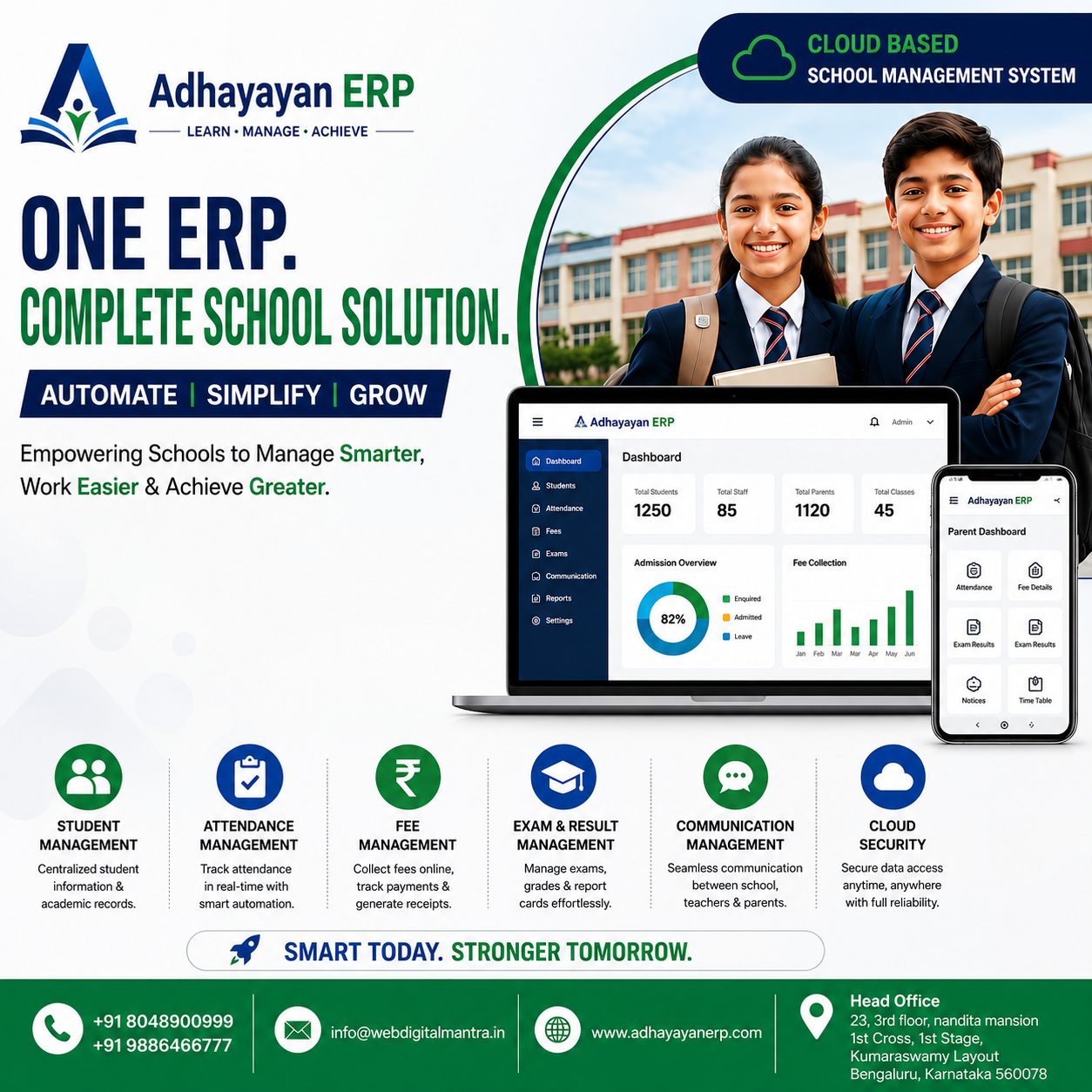
This is where solutions such as Adhayayan ERP can help schools move towards a more connected and digitally managed education system.
What Are Mobile Apps in School Education?
Mobile apps in education are applications designed to support teaching, learning, communication, and school management through smartphones and tablets.
Instead of depending completely on paper notices, diaries, phone calls, or multiple communication channels, schools can use a mobile app to provide important information in one place.
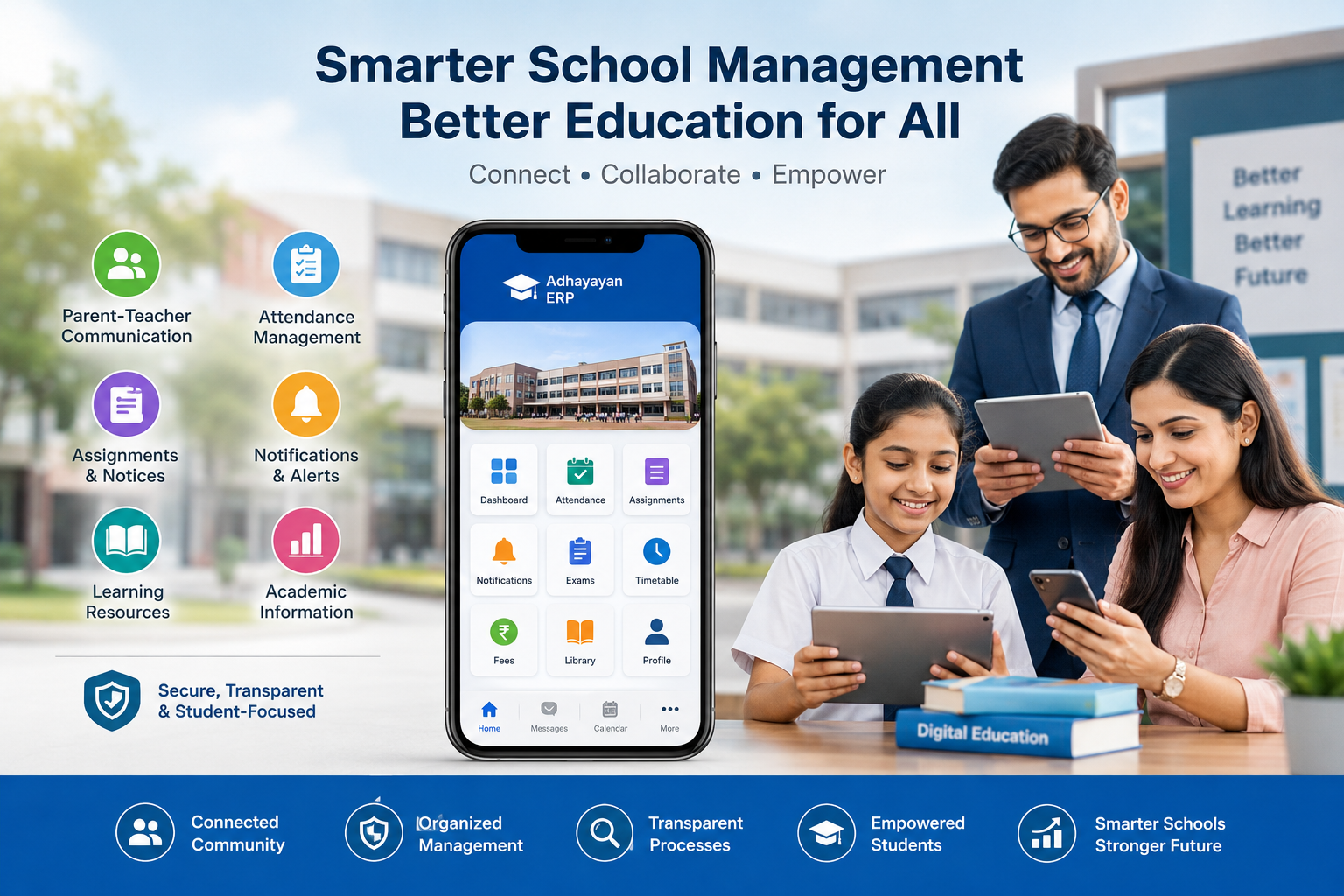
Depending on the features available, a school mobile app may support:
- Student attendance
- Homework and assignments
- Class schedules
- Examination information
- Academic updates
- School announcements
- Parent-teacher communication
- Fee-related information
- Learning materials
- Student performance updates
- Notifications and reminders
The goal is not simply to introduce another technology into the classroom. The real purpose is to make education and school management simpler, faster, and more connected.
Technology has changed the way we learn, communicate, and manage everyday activities. Schools are also adopting digital solutions to make education more accessible, organized, and engaging. Among these technologies, mobile apps have become an important part of modern school education.
Today, students and parents already use smartphones for communication, learning, reminders, and accessing information. When schools use mobile applications effectively, they can bring important academic and administrative activities together in one convenient platform.
A well-designed school mobile app can help teachers communicate with students and parents, provide learning resources, share important announcements, track attendance, manage assignments, and simplify many routine school activities.
This is where solutions such as Adhayayan ERP can help schools move towards a more connected and digitally managed education system.
What Are Mobile Apps in School Education?
Mobile apps in education are applications designed to support teaching, learning, communication, and school management through smartphones and tablets.
Instead of depending completely on paper notices, diaries, phone calls, or multiple communication channels, schools can use a mobile app to provide important information in one place.
Depending on the features available, a school mobile app may support:
- Student attendance
- Homework and assignments
- Class schedules
- Examination information
- Academic updates
- School announcements
- Parent-teacher communication
- Fee-related information
- Learning materials
- Student performance updates
- Notifications and reminders
The goal is not simply to introduce another technology into the classroom. The real purpose is to make education and school management simpler, faster, and more connected.
How Mobile Apps Are Improving School Education
1. Better Communication Between Schools and Parents
Communication is one of the biggest advantages of a school mobile app.
Schools can share announcements, reminders, academic updates, events, and other important information directly with parents. This reduces dependency on printed notices and helps parents stay informed.
For example, instead of waiting for a student to bring a circular home, parents can receive the information directly through the app.
This creates a stronger connection between school, parents, teachers, and students.
2. Easy Access to Learning Resources
Students can access educational materials through their mobile devices from almost anywhere.
Teachers can share:
- Notes
- Study materials
- Assignments
- Worksheets
- Reference resources
- Revision materials
- Important academic updates
This gives students greater flexibility when preparing for classes and examinations.
Mobile learning can also be useful when students are unable to attend school physically, allowing them to stay connected with their academic activities.
How Mobile Apps Are Improving School Education
1. Better Communication Between Schools and Parents
Communication is one of the biggest advantages of a school mobile app.
Schools can share announcements, reminders, academic updates, events, and other important information directly with parents. This reduces dependency on printed notices and helps parents stay informed.
For example, instead of waiting for a student to bring a circular home, parents can receive the information directly through the app.
This creates a stronger connection between school, parents, teachers, and students.
2. Easy Access to Learning Resources
Students can access educational materials through their mobile devices from almost anywhere.
Teachers can share:
- Notes
- Study materials
- Assignments
- Worksheets
- Reference resources
- Revision materials
- Important academic updates
This gives students greater flexibility when preparing for classes and examinations.
Mobile learning can also be useful when students are unable to attend school physically, allowing them to stay connected with their academic activities.
3. Simplified Attendance Management
Attendance is an essential part of school administration.
With digital attendance features, teachers can record attendance more efficiently, while parents can receive updates depending on the school's system.
Digital attendance records can also make it easier for school management to monitor attendance patterns and identify students who may require additional attention.
This reduces manual paperwork and makes attendance information easier to manage.
4. Improved Student Performance Tracking
Understanding a student's academic progress is important for teachers and parents.
A connected school management system can help organize information such as:
- Examination results
- Assignment performance
- Attendance
- Academic progress
- Teacher feedback
When this information is properly organized, teachers and parents can better understand where a student is performing well and where additional support may be required.
The focus shifts from simply recording marks to understanding the student's overall academic development.
5. Convenient Homework and Assignment Management
Managing homework through a mobile app can make the process more organized.
Teachers can share assignments digitally, while students can check what work needs to be completed. Parents can also stay aware of their child's academic responsibilities.
This can reduce situations where students forget assignments or lose physical homework instructions.
More importantly, it creates a consistent communication channel between teachers and students.
3. Simplified Attendance Management
Attendance is an essential part of school administration.
With digital attendance features, teachers can record attendance more efficiently, while parents can receive updates depending on the school's system.
Digital attendance records can also make it easier for school management to monitor attendance patterns and identify students who may require additional attention.
This reduces manual paperwork and makes attendance information easier to manage.
4. Improved Student Performance Tracking
Understanding a student's academic progress is important for teachers and parents.
A connected school management system can help organize information such as:
- Examination results
- Assignment performance
- Attendance
- Academic progress
- Teacher feedback
When this information is properly organized, teachers and parents can better understand where a student is performing well and where additional support may be required.
The focus shifts from simply recording marks to understanding the student's overall academic development.
5. Convenient Homework and Assignment Management
Managing homework through a mobile app can make the process more organized.
Teachers can share assignments digitally, while students can check what work needs to be completed. Parents can also stay aware of their child's academic responsibilities.
This can reduce situations where students forget assignments or lose physical homework instructions.
More importantly, it creates a consistent communication channel between teachers and students.
6. Faster School Notifications
Important school information often needs to reach parents and students quickly.
Mobile notifications can be used for:
- School events
- Examination schedules
- Holidays
- Important announcements
- Assignment reminders
- Parent meetings
- Emergency updates
Instead of relying only on physical notices or messages passed through students, schools can communicate important information more efficiently.
7. Supporting Teachers in Their Daily Work
Mobile technology is not only useful for students and parents. Teachers can also benefit from digital school management tools.
Depending on the system, teachers may be able to manage attendance, access student information, communicate with parents, check schedules, and update academic information through a centralized platform.
This can reduce repetitive administrative work and allow teachers to spend more time focusing on teaching and student development.
6. Faster School Notifications
Important school information often needs to reach parents and students quickly.
Mobile notifications can be used for:
- School events
- Examination schedules
- Holidays
- Important announcements
- Assignment reminders
- Parent meetings
- Emergency updates
Instead of relying only on physical notices or messages passed through students, schools can communicate important information more efficiently.
7. Supporting Teachers in Their Daily Work
Mobile technology is not only useful for students and parents. Teachers can also benefit from digital school management tools.
Depending on the system, teachers may be able to manage attendance, access student information, communicate with parents, check schedules, and update academic information through a centralized platform.
This can reduce repetitive administrative work and allow teachers to spend more time focusing on teaching and student development.
8. More Convenient School Management
School education involves much more than classroom teaching.
School administrators need to manage student information, attendance, communication, academic activities, fees, staff-related information, and many other processes.
A school ERP with mobile accessibility can bring different functions together and provide school management with better visibility.
This can help reduce paperwork, improve data organization, and make everyday administrative processes more efficient.
Benefits of Mobile Apps for Different Users
For Students
Mobile apps can help students:
- Access learning materials easily
- Check assignments and homework
- Receive important notifications
- Stay updated with schedules
- Review academic information
- Stay connected with teachers and school activities
For Parents
Parents can:
- Receive school notifications
- Monitor attendance
- Stay informed about assignments
- Follow academic progress
- Receive important school updates
- Communicate more conveniently with the school
For Teachers
Teachers can:
- Manage attendance digitally
- Share assignments and resources
- Communicate with parents
- Access student information
- Provide academic updates
- Reduce routine administrative work
For School Management
School administrators can:
- Organize student data
- Improve communication
- Reduce paperwork
- Monitor school activities
- Access information more efficiently
- Make better-informed administrative decisions
8. More Convenient School Management
School education involves much more than classroom teaching.
School administrators need to manage student information, attendance, communication, academic activities, fees, staff-related information, and many other processes.
A school ERP with mobile accessibility can bring different functions together and provide school management with better visibility.
This can help reduce paperwork, improve data organization, and make everyday administrative processes more efficient.
Benefits of Mobile Apps for Different Users
For Students
Mobile apps can help students:
- Access learning materials easily
- Check assignments and homework
- Receive important notifications
- Stay updated with schedules
- Review academic information
- Stay connected with teachers and school activities
For Parents
Parents can:
- Receive school notifications
- Monitor attendance
- Stay informed about assignments
- Follow academic progress
- Receive important school updates
- Communicate more conveniently with the school
For Teachers
Teachers can:
- Manage attendance digitally
- Share assignments and resources
- Communicate with parents
- Access student information
- Provide academic updates
- Reduce routine administrative work
For School Management
School administrators can:
- Organize student data
- Improve communication
- Reduce paperwork
- Monitor school activities
- Access information more efficiently
- Make better-informed administrative decisions
Mobile Apps and the Future of Digital Education
The role of mobile apps in education is expected to continue growing as schools become more comfortable with digital technologies.
However, technology should support education rather than replace teachers. A mobile app cannot replace the personal guidance, motivation, creativity, and emotional support provided by educators.
The most effective approach is to combine technology with good teaching practices.
When schools use mobile apps as part of a broader school management and learning strategy, they can create an environment where information is easier to access, communication is more transparent, and routine processes are better organized.
Why Schools Need an Integrated ERP Solution
Using separate applications for attendance, communication, fees, academic records, and other activities can sometimes make school management more complicated.
An integrated School ERP can bring multiple functions together in one system.
This allows schools to manage their operations more systematically while giving teachers, parents, and students access to relevant information through digital platforms.
Solutions such as Adhayayan ERP can support schools in their journey toward smarter and more connected education management.
Instead of treating technology as an additional task, schools can use it to simplify existing processes and improve the overall educational experience.
Mobile Apps and the Future of Digital Education
The role of mobile apps in education is expected to continue growing as schools become more comfortable with digital technologies.
However, technology should support education rather than replace teachers. A mobile app cannot replace the personal guidance, motivation, creativity, and emotional support provided by educators.
The most effective approach is to combine technology with good teaching practices.
When schools use mobile apps as part of a broader school management and learning strategy, they can create an environment where information is easier to access, communication is more transparent, and routine processes are better organized.
Why Schools Need an Integrated ERP Solution
Using separate applications for attendance, communication, fees, academic records, and other activities can sometimes make school management more complicated.
An integrated School ERP can bring multiple functions together in one system.
This allows schools to manage their operations more systematically while giving teachers, parents, and students access to relevant information through digital platforms.
Solutions such as Adhayayan ERP can support schools in their journey toward smarter and more connected education management.
Instead of treating technology as an additional task, schools can use it to simplify existing processes and improve the overall educational experience.
Things Schools Should Consider Before Choosing a Mobile App
Not every education app will meet the requirements of every school. Before choosing a solution, schools should consider:
User-Friendly Interface
The application should be simple enough for teachers, parents, students, and administrators to use without extensive technical knowledge.
Data Security
Student and school information is sensitive. Schools should choose platforms that prioritize appropriate security and privacy practices.
Scalability
The solution should be capable of supporting the school's changing requirements as the number of students, teachers, and digital activities grows.
Integration
A mobile app becomes more useful when it works together with other school management functions rather than operating as an isolated application.
Reliable Support
Schools should also consider the availability of technical support, updates, and assistance when selecting a digital platform.
Things Schools Should Consider Before Choosing a Mobile App
Not every education app will meet the requirements of every school. Before choosing a solution, schools should consider:
User-Friendly Interface
The application should be simple enough for teachers, parents, students, and administrators to use without extensive technical knowledge.
Data Security
Student and school information is sensitive. Schools should choose platforms that prioritize appropriate security and privacy practices.
Scalability
The solution should be capable of supporting the school's changing requirements as the number of students, teachers, and digital activities grows.
Integration
A mobile app becomes more useful when it works together with other school management functions rather than operating as an isolated application.
Reliable Support
Schools should also consider the availability of technical support, updates, and assistance when selecting a digital platform.
Mobile apps are becoming an important part of modern school education. From improving parent-teacher communication to simplifying attendance, assignments, notifications, learning resources, and academic information, mobile technology can make many aspects of education more convenient.
However, the real value of a mobile app comes from how effectively it is integrated into the school's overall management and teaching process.
With the right technology, schools can create a more connected, organized, transparent, and student-focused educational environment.
As digital education continues to evolve, solutions such as Adhayayan ERP can help schools take meaningful steps toward smarter school management and a better experience for students, parents, teachers, and administrators.
Mobile apps are becoming an important part of modern school education. From improving parent-teacher communication to simplifying attendance, assignments, notifications, learning resources, and academic information, mobile technology can make many aspects of education more convenient.
However, the real value of a mobile app comes from how effectively it is integrated into the school's overall management and teaching process.
With the right technology, schools can create a more connected, organized, transparent, and student-focused educational environment.
As digital education continues to evolve, solutions such as Adhayayan ERP can help schools take meaningful steps toward smarter school management and a better experience for students, parents, teachers, and administrators.