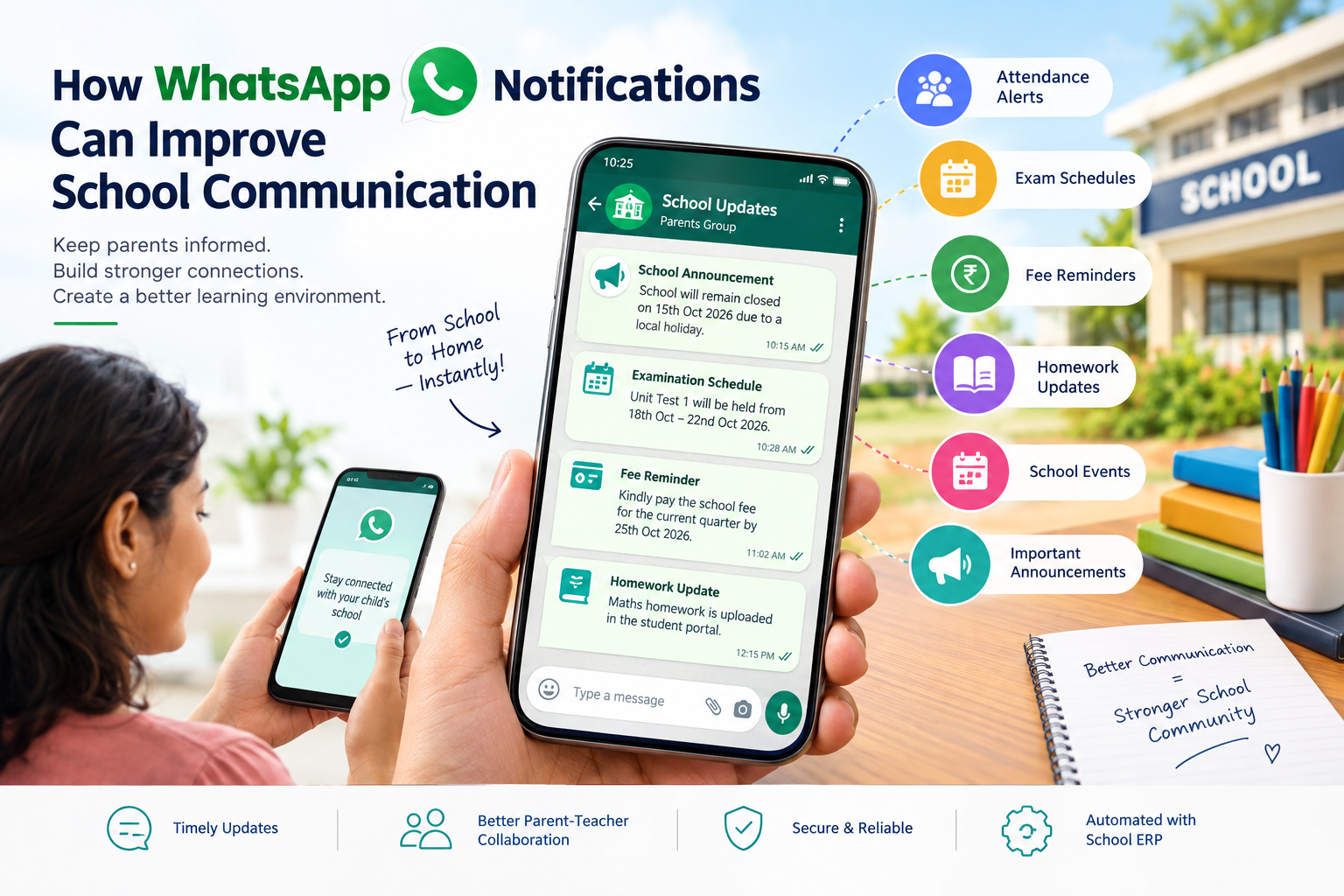
How WhatsApp Notifications Can Improve School Communication
Short answer: WhatsApp notifications help schools improve communication with parents by delivering timely updates about student attendance, examination schedules, fee reminders, homework, school events, and important announcements. When integrated with school ERP software, these notifications can automate routine messages, reduce administrative workload, and strengthen parent-teacher communication. By using accurate contact details, appropriate consent, and secure communication practices, schools can create a more connected and informed learning environment.
Last Updated: October 15, 2026
Category: School ERP / Education Technology
Search Intent: Informational
Target Audience: School administrators, principals, teachers, parents, and education technology providers
Introduction
Effective communication between schools and parents is essential for creating a positive learning environment. Parents want to stay informed about their children's attendance, academic progress, school activities, examinations, homework, and important announcements. However, traditional communication methods, such as printed circulars, diary notes, and phone calls, can sometimes lead to delays, missed messages, and unnecessary confusion.
This is where WhatsApp notifications for schools can make a meaningful difference.
WhatsApp is a familiar messaging platform that allows schools to share important updates directly with parents through messages, reminders, and announcements. When integrated with a school management system or school ERP software, WhatsApp notifications can help automate routine communication, reduce manual work, and keep parents informed in a timely manner.
In this article, we will explore how WhatsApp notifications improve school communication, their key benefits, practical use cases, implementation strategies, and how schools can use them responsibly to strengthen parent-teacher relationships.
Table of Contents
What Are WhatsApp Notifications for Schools?
Why Is School Communication Important?
7 Ways WhatsApp Notifications Improve School Communication
Common Uses of WhatsApp Notifications in Schools
WhatsApp Notifications vs. Traditional School Communication
How School ERP Software Simplifies WhatsApp Communication
Best Practices for Using WhatsApp Notifications in Schools
Challenges and How to Overcome Them
How to Implement WhatsApp Notifications in Your School
The Future of Digital Communication in Education
Frequently Asked Questions
Conclusion
What Are WhatsApp Notifications for Schools?
WhatsApp notifications for schools are digital messages sent to parents, guardians, teachers, or students to communicate important school-related information.
These notifications can include attendance alerts, examination schedules, fee reminders, homework updates, timetable changes, holiday announcements, event invitations, and meeting reminders.
Schools can send messages manually for occasional updates or use an integrated school ERP system to automate selected notifications based on specific events or actions.
For example, when a student is marked absent in the school's attendance system, an authorized workflow can send an attendance notification to the registered parent or guardian, subject to the school's configuration and applicable consent requirements.
This approach helps schools communicate more efficiently while reducing repetitive administrative tasks.
Why Is School Communication Important?
School communication plays an important role in connecting teachers, parents, students, and administrators. When information reaches parents on time, they can respond appropriately and support their children's education more effectively.
Poor communication may lead to missed examination dates, confusion about school schedules, delayed fee payments, and misunderstandings between parents and school staff.
A reliable communication process helps schools:
Keep parents informed about academic and administrative updates.
Encourage stronger parent-teacher collaboration.
Share attendance and punctuality information promptly.
Reduce dependence on printed notices and repetitive phone calls.
Improve the coordination of school events and activities.
Build trust through timely and consistent communication.
Digital communication tools, including WhatsApp notifications, can support these goals by making important updates easier to distribute and access.
7 Ways WhatsApp Notifications Improve School Communication
1. Instant School Announcements
Sharing announcements through printed notices or student diaries can be time-consuming. In some cases, students may forget to show notices to their parents.
WhatsApp notifications provide a convenient way to communicate important updates directly to registered parents and guardians.
Schools can use them to announce:
School holidays and unexpected closures.
Changes to school timings.
Examination dates and revised timetables.
Parent-teacher meetings.
Sports days, cultural programmes, and annual functions.
Example: If a school changes its opening time because of a local event, the administration can notify parents promptly rather than relying only on printed circulars.
This helps reduce confusion and ensures that families have access to the latest information.
2. Timely Student Attendance Alerts
Student attendance is an important part of academic monitoring. Parents need to know when their children are absent or when attendance-related concerns arise.
When attendance records are connected to a school ERP system, the school may configure WhatsApp notifications to inform parents about recorded absences, subject to appropriate verification and system settings.
For example:
"Dear Parent, our records indicate that your child was marked absent today. Please contact the school office if you require clarification."
Such notifications can help parents identify attendance issues earlier and contact the school when necessary.
Schools should ensure that alerts are accurate, sent to verified contacts, and handled according to their attendance and safeguarding policies.
3. Better Parent-Teacher Communication
Strong parent-teacher relationships support students' academic and personal development. However, arranging calls or in-person meetings for every routine update can be difficult.
WhatsApp can make routine communication more convenient by helping teachers and school administrators share reminders, meeting schedules, general progress updates, and follow-up information.
For example, a teacher can send a parent-teacher meeting reminder with the date, time, and instructions for attending.
For sensitive discussions about a student's performance, behaviour, or personal circumstances, schools should use an appropriate private and secure communication channel rather than sharing confidential information in group chats.
4. Automated Fee Payment Reminders
Managing fee collection and payment follow-ups can require considerable administrative effort.
Schools can use an integrated school management system to schedule fee reminders and send payment-related notifications through supported messaging services.
These notifications may include:
Upcoming fee payment dates.
Payment confirmation messages.
Outstanding balance reminders.
Information about available payment methods.
Instructions for contacting the accounts department.
Example: A school may send a reminder several days before the fee deadline and another notification after the due date, if appropriate under its fee policy.
Automated reminders can reduce repetitive follow-up work and help parents keep track of payment deadlines. Messages should be discreet and should never disclose a family's financial information to other parents.
5. Homework and Examination Updates
Parents often want to understand what their children need to complete at home and how to prepare for upcoming examinations.
WhatsApp notifications can help schools communicate homework reminders, examination schedules, project deadlines, syllabus updates, and study instructions.
For example, a teacher may share a reminder that a science project must be submitted on Friday or notify parents that the examination timetable has been published.
When teachers use a consistent communication process, parents can better plan study time and provide support at home.
Schools should ensure that notifications complement classroom instruction and the official student portal rather than creating unnecessary message overload.
6. Improved Coordination of School Events
School events require coordination among teachers, parents, students, and administrative staff. Important details may include registration deadlines, reporting times, dress codes, transportation arrangements, and items students need to bring.
WhatsApp notifications allow schools to distribute these details in a convenient format.
Schools can send reminders for:
Annual day celebrations.
Sports competitions.
Educational trips.
Science exhibitions.
Cultural programmes.
Parent orientation sessions.
Messages can also direct parents to an official school website or portal for complete instructions, permission forms, and updated schedules.
This makes event-related communication easier to organize and helps families prepare in advance.
7. Reduced Administrative Work
School administrators and teachers often spend time repeating the same information to multiple parents. Manual calls and individual messages can become difficult to manage as the number of students increases.
With an appropriate school ERP integration, routine notifications can be generated from relevant school records and delivered through a supported WhatsApp messaging solution.
For example, the system may be configured to send attendance alerts, payment reminders, meeting notifications, and general announcements when specific conditions are met.
This can reduce repetitive work and allow school staff to focus more on teaching, student support, and essential administrative responsibilities.
Automation should still include message review, delivery monitoring, accurate contact records, and a process for handling errors or parent queries.
Common Uses of WhatsApp Notifications in Schools
WhatsApp notifications can support several school operations when configured appropriately.
| School Activity | Example Notification | Main Benefit |
|---|---|---|
| Attendance | Student absence alert | Keeps parents informed |
| Fee management | Upcoming payment reminder | Helps track payment deadlines |
| Examinations | Exam timetable announcement | Supports better preparation |
| Homework | Assignment deadline reminder | Encourages timely completion |
| School events | Annual day invitation | Improves event coordination |
| Parent-teacher meetings | Meeting date and time | Simplifies scheduling |
| Holidays | School closure announcement | Prevents schedule confusion |
| Transport | Route or pickup update | Communicates relevant changes |
| Admissions | Application status update | Keeps applicants informed |
| General administration | Circular or policy update | Centralizes routine communication |
The exact features available depend on the messaging provider, school ERP platform, permissions, and integration settings.
WhatsApp Notifications vs. Traditional School Communication
Schools can use different channels to communicate with parents. WhatsApp notifications offer convenience for many routine updates, while traditional methods remain useful in situations that require formal documentation or direct discussion.
| Feature | Printed Notices | Phone Calls | WhatsApp Notifications |
|---|---|---|---|
| Delivery speed | Depends on distribution | Immediate when answered | Usually rapid, depending on connectivity |
| Communication effort | Printing and distribution | Staff time for each call | Can be automated where supported |
| Message record | Physical copy | May require manual notes | Conversation or delivery records may be available |
| Multiple recipients | Requires distribution | Repeated calls | Supports authorized individual or group messaging |
| Parent convenience | Requires access to the notice | Requires availability for a call | Can be read when convenient |
| Sensitive discussions | Can be delivered privately | Useful for direct discussion | Requires careful privacy controls |
| Internet required | No | No, for regular mobile calls | Yes |
Important: WhatsApp should complement, not completely replace, official school communication channels. Schools may still need signed consent forms, formal circulars, direct phone calls, or secure portals for specific purposes.
How School ERP Software Simplifies WhatsApp Communication
A school ERP system brings key administrative processes together in one digital platform. When integrated with an authorized WhatsApp messaging service, it can help schools coordinate communication with information already maintained in their school management system.
Here are some ways this integration can work.
Centralized Student Information
A school ERP system can maintain student records, parent contact details, class information, and attendance records in one place. Accurate records help the school direct notifications to the appropriate registered contact.
Access to student information should be limited to authorized staff.
Event-Based Notifications
Notifications can be triggered by configured events, such as an attendance entry, an upcoming fee deadline, or a scheduled school event.
This reduces the need to prepare every routine message manually.
Consistent Communication
Schools can create approved message templates for common situations, including absence alerts, examination reminders, and holiday announcements.
Consistent templates help reduce errors and make messages easier for parents to understand.
Communication Records
Depending on the integration, schools may be able to review message status, delivery reports, and relevant communication history.
These records can help administrators investigate delivery issues and improve communication procedures. A sent or delivered status should not be treated as proof that a parent has read or understood a message.
Easier Administrative Management
By connecting school information and communication workflows, an ERP system can help reduce duplicated work across departments.
For schools exploring digital administration, an education management platform such as Adhyayan ERP may be worth evaluating for its available communication and school management capabilities. Schools should confirm the exact WhatsApp integration, automation options, pricing, and privacy controls with the provider before implementation.
Best Practices for Using WhatsApp Notifications in Schools
Using WhatsApp effectively requires more than sending frequent messages. Schools should establish a clear communication policy that balances convenience, accuracy, privacy, and accessibility.
1. Use Verified Parent Contact Details
Maintain updated phone numbers for parents and guardians. Establish a procedure to verify changes so that messages are not sent to an incorrect recipient.
2. Obtain Appropriate Consent
Explain how the school will use WhatsApp for communication and obtain the required permissions or consent. Follow applicable privacy requirements and the messaging platform's policies.
3. Keep Messages Short and Clear
Use simple language, meaningful headings, and clear instructions. Include dates, times, deadlines, and contact details wherever necessary.
4. Avoid Excessive Notifications
Send messages when there is a genuine need. Too many reminders can overwhelm parents and make important announcements easier to miss.
5. Protect Student Privacy
Avoid sharing sensitive student information, medical details, personal records, or financial information in public groups. Use appropriate private channels and access controls.
6. Follow WhatsApp Business Policies
Schools using the WhatsApp Business Platform should follow its applicable messaging, template, consent, and customer-service requirements. Certain business-initiated messages may require approved templates, depending on the platform's current rules and the conversation context.
7. Provide an Alternative Communication Channel
Not every parent may have reliable internet access or use WhatsApp regularly. Schools should provide suitable alternatives, such as SMS, phone calls, email, printed notices, or an official parent portal.
8. Monitor and Improve Communication
Review failed deliveries, parent feedback, response times, and common communication issues. Use these insights to improve contact records and notification schedules.
Challenges and How to Overcome Them
Although WhatsApp notifications offer several advantages, schools should consider potential limitations before adopting them.
Incorrect contact information: Outdated numbers can prevent messages from reaching the intended parent. Regularly verify contact details and maintain a clear update process.
Message overload: Frequent notifications may cause parents to ignore important updates. Prioritize essential information and create reasonable messaging schedules.
Privacy concerns: Student details may be exposed if messages are sent to the wrong recipient or shared in inappropriate groups. Use verified contacts, restricted access, and approved communication procedures.
Internet connectivity issues: Messages may be delayed when a parent has limited internet access. Provide alternative channels for essential announcements.
Unclear responsibilities: Teachers and administrators may send duplicate or inconsistent messages. Define who can send each type of notification and establish approved templates.
Limited personal interaction: Automated messages cannot replace meaningful conversations about a student's development. Use direct meetings or calls when a discussion requires context, empathy, or individual attention.
By addressing these challenges, schools can use WhatsApp as part of a reliable and inclusive communication strategy.
How to Implement WhatsApp Notifications in Your School
Schools can introduce WhatsApp notifications gradually instead of automating every communication activity at once.
Step 1: Identify Communication Needs
List the most common reasons the school contacts parents. Attendance alerts, examination reminders, holiday announcements, and parent-teacher meeting updates are useful starting points.
Step 2: Choose the Right Communication Method
Decide whether staff will send occasional manual messages or whether the school needs an integrated messaging service connected to its ERP system.
For large schools, an authorized business messaging integration may offer better workflow management than relying on individual staff members' personal accounts.
Step 3: Prepare and Verify Contact Records
Collect the necessary parent or guardian contact details, verify them, and establish appropriate consent and preference records.
Step 4: Create Message Templates
Prepare clear templates for recurring communication. For example:
"Dear Parent, this is a reminder that the parent-teacher meeting is scheduled for [date] at [time]. Please contact the school office if you need assistance."
Review all templates before use to ensure that they contain accurate information and appropriate language.
Step 5: Configure and Test Notifications
If the school uses ERP integration, configure the relevant triggers, recipients, schedules, and message templates. Test the workflow with authorized users before deploying it school-wide.
Step 6: Train Teachers and Administrative Staff
Explain when to send notifications, how to protect student information, and how to respond to parent questions.
Step 7: Evaluate the Results
Track useful measures such as delivery failures, repeated parent queries, administrative time spent on routine communication, and feedback from parents and staff.
Use these findings to refine the system and improve the overall communication experience.
The Future of Digital Communication in Education
Digital communication is becoming an important part of school administration. As schools adopt more connected management systems, communication workflows can become more organized, timely, and easier to monitor.
WhatsApp notifications can work alongside student information systems, parent portals, email, SMS, and other digital tools. In some implementations, schools may also use automation to schedule reminders and coordinate notifications with attendance, examinations, or fee management.
However, effective communication is not simply about adopting new technology. It also depends on accurate information, respectful messaging, data protection, and meaningful relationships between educators and families.
Schools that combine suitable technology with thoughtful communication policies can create a more transparent and supportive educational environment.
Frequently Asked Questions (FAQs)
1. How do WhatsApp notifications improve school communication?
WhatsApp notifications help schools share attendance updates, examination schedules, fee reminders, holiday announcements, and event details with registered parents. They can reduce communication delays and make routine updates easier to manage.
2. Can schools automate WhatsApp notifications?
Yes. Schools can configure automated notifications through an appropriate school ERP integration and an authorized WhatsApp messaging solution. Automation depends on the provider's capabilities, system configuration, consent, and applicable messaging rules.
3. What types of school notifications can be sent through WhatsApp?
Common examples include attendance alerts, fee reminders, examination schedules, homework deadlines, school holidays, parent-teacher meeting reminders, transport updates, and event announcements.
4. Is WhatsApp suitable for parent-teacher communication?
Yes, WhatsApp can be suitable for routine updates and scheduling. Sensitive discussions about academic performance, behaviour, health, or personal circumstances should use an appropriate private communication channel.
5. How can school ERP software help with WhatsApp notifications?
A school ERP system can connect student records and administrative workflows with messaging services. Depending on the integration, it may support event-based alerts, message templates, scheduled reminders, and communication records.
6. Are WhatsApp notifications better than SMS for schools?
Neither channel is best for every situation. WhatsApp can support richer messages and convenient conversations, while SMS can reach phones without mobile internet access. Schools should choose based on urgency, accessibility, privacy, cost, and parent preferences.
7. How can schools protect student information when using WhatsApp?
Schools should verify recipient details, obtain appropriate consent, restrict staff access, avoid sharing confidential information in groups, follow relevant data protection requirements, and use secure alternatives when necessary.
8. Do WhatsApp notifications guarantee that parents will read school messages?
No. A message being sent or delivered does not guarantee that the recipient has read or understood it. Schools should use alternative follow-up methods for urgent or critical information.
9. Can WhatsApp notifications reduce teachers' administrative workload?
They can reduce repetitive communication tasks when routine messages are automated appropriately. The actual time saved depends on school size, workflow design, integration quality, and the number of notifications required.
10. What should schools consider before implementing WhatsApp notifications?
Schools should assess their communication needs, messaging provider, integration capabilities, costs, consent procedures, student data protection, staff training, and alternative channels for parents who cannot use WhatsApp.
Conclusion
Effective school communication helps parents stay informed, supports teachers, and improves coordination across school activities. WhatsApp notifications provide a convenient way to share routine announcements, attendance alerts, examination reminders, fee updates, and event information.
When combined with a suitable school ERP system, these notifications can reduce repetitive administrative tasks and create more organized communication workflows. However, schools must also prioritize accuracy, privacy, appropriate consent, and alternative communication options.
The goal is not simply to send more messages. It is to ensure that the right information reaches the right person at the right time.
Looking to improve communication between your school and parents? Explore how a suitable school management system can help organize administrative tasks, streamline routine updates, and support a better-connected school community.
Contact your preferred school ERP provider to discuss the communication features and integrations that fit your institution's needs.
SEO Optimization Checklist
Primary and Secondary Keywords
Primary target keyword: WhatsApp notifications for schools
Secondary keywords:
School communication system
WhatsApp for school communication
Parent-teacher communication
School ERP software
School management system
Automated school notifications
Parent communication app
Student attendance alerts
School announcement messages
Digital communication in education
Recommended Meta Tags
SEO title: How WhatsApp Notifications Improve School Communication
Meta description: Discover how WhatsApp notifications improve school communication through attendance alerts, fee reminders, exam updates, and better parent-teacher engagement.
URL slug: whatsapp-notifications-school-communication
Suggested URL: https://www.yourdomain.com/whatsapp-notifications-school-communication/
Canonical URL: Use the final, preferred URL of the published article.
Meta keywords: WhatsApp notifications for schools, school communication system, parent-teacher communication, school ERP software, automated school notifications
Blog excerpt: Learn how WhatsApp notifications help schools share important updates, improve parent-teacher communication, automate reminders, and streamline school administration.
Open Graph title: How WhatsApp Notifications Can Improve School Communication
Open Graph description: Explore the benefits of WhatsApp notifications for schools, including attendance alerts, examination updates, fee reminders, and efficient parent communication.
Robots directives: index, follow for a public article intended to appear in search results.
Sitemap: Include the published canonical URL in your XML sitemap.
Suggested image alt text: WhatsApp notifications helping schools improve communication between teachers and parents.
Recommended Internal Links
Add relevant internal links naturally within the article to pages on your website:
School ERP Software
Parent-Teacher Communication System
Student Attendance Management
School Fee Management Software
School Admission Management System
Use descriptive anchor text and link only to relevant pages that actually exist on your website.
Image Recommendations
Create an original featured image showing a teacher and parent communicating through a smartphone, with a school setting in the background.
Suggested image filename: whatsapp-notifications-school-communication.webp
Suggested image alt text: Teacher and parent using WhatsApp notifications for school communication.
Suggested image caption: WhatsApp notifications help schools share important updates with parents conveniently.
Final SEO Recommendations
Use only one clear H1 heading for the main article title.
Maintain a logical H2 and H3 heading hierarchy.
Include the primary keyword naturally in the title, introduction, a relevant subheading, and conclusion.
Add relevant internal links and credible external references where useful.
Use compressed images in WebP format with descriptive filenames and alt text.
Add Article or BlogPosting structured data with accurate author, publication date, and modification date.
Add FAQ structured data only when eligible and compliant with current Google guidelines; FAQ markup does not guarantee a rich result.
Avoid keyword stuffing, fabricated statistics, and unsupported claims.
Test mobile usability, page speed, indexing, and canonical configuration before publishing.
Important publishing note: Replace the example domain with your actual website URL. If this article is for Adhyayan ERP, add internal links to the corresponding live pages on adhayayanerp.com and verify the product features before describing them as available.
- Instant Communication
- Schools can share important announcements, holiday updates, and schedule changes with parents through WhatsApp messages.
- Attendance Alerts
- Schools can notify parents about recorded student absences using an appropriately configured school management system.
Frequently asked questions
1. How do WhatsApp notifications improve school communication? WhatsApp notifications help schools share important updates about attendance, examinations, homework, fee reminders, holidays, and school events. They enable convenient communication between teachers, parents, and school administrators.
1. How do WhatsApp notifications improve school communication? WhatsApp notifications help schools share important updates about attendance, examinations, homework, fee reminders, holidays, and school events. They enable convenient communication between teachers, parents, and school administrators.
2. What are the benefits of WhatsApp notifications for schools?
The main benefits include faster communication, automated reminders, reduced administrative workload, improved parent engagement, and better coordination of school activities.
- WhatsApp has reported more than 2 billion users worldwide, demonstrating its broad reach as a messaging platform. Source: WhatsApp.
- 2 billion+ users