How Can Schools Adopt Competency Based Education In India?
Competency based education moves students ahead when they prove they can apply a skill, not when a calendar says so. NEP 2020 points Indian schools toward it across 3 areas: curriculum, pedagogy and assessment.
Most principals like the idea but worry about the paperwork it creates. Tracking mastery for hundreds of students needs more than a marks register, and a school ERP that supports data-driven decisions is a sensible place to begin. This guide covers the meaning, the policy, classroom practice and the tools.
At A Glance
• Policy Anchor: NEP 2020
• Shift Covers: Curriculum, pedagogy and assessment
• Price: From ₹20 per student per month
• Best pilot size: one subject in one grade for a single term
• Mastery is shown through repeated evidence, not one exam paper.
What Does Competency In Education Actually Mean?
Competency in education means a student can combine knowledge, skills and attitudes to solve a real task. Competency based education measures that ability directly, rather than counting chapters covered or facts memorised.
A competency is bigger than a learning objective. An objective says a student will list the parts of a plant. A competency says the student can plan and explain a simple experiment on plant growth.
Three features appear in every sound definition:
• Clear statements of what students can do at each stage
• Evidence gathered many times and in many forms
• Support and re-teaching until the student reaches the expected level
Here is how the idea looks in three subjects:
• Mathematics: the student picks the right operation for a shopping bill problem and explains the choice
• Language: the student writes a clear request to the principal and supports it with two reasons
• Science: the student designs a fair test, records results and states a conclusion
Because the unit of progress is the skill, a student who has mastered fractions can move on while another gets a second attempt with fresh examples. Nobody is labelled slow. The student simply needs more practice time.
How Is Competency Based Learning Different From Traditional Teaching?
Competency based learning lets students move ahead once they show mastery, while traditional teaching moves a whole class on a fixed calendar. Competency based education therefore changes the pace, the evidence collected and the feedback given.
|
Area |
Traditional Classroom |
Competency Based Classroom |
|
Pace |
Fixed by the calendar |
Flexible, based on mastery |
|
Evidence |
One or two term exams |
Many tasks, projects and quizzes |
|
Feedback |
Marks at the end of term |
Comments during learning |
|
Report card |
Subject totals |
Skill by skill progress |
|
Teacher role |
Delivers content |
Coaches and checks understanding |
Students gain too. A learner who struggles with one skill is no longer hidden inside an average. The record points to the exact gap, and the teacher can act on it within the week.
Teachers who already enter marks digitally have a head start, as our academic management system guide shows for exam scheduling, grade calculations and report cards.
Grades do not disappear. They are built from evidence tied to each skill, which makes a score far easier to explain to a parent.
What Does NEP 2020 Say About A Competency Based Curriculum?
A competency based curriculum defines what students should be able to do at each stage, then builds lessons backwards from those abilities. Under NEP 2020, competency based education is a stated priority, with change planned across curriculum, pedagogy and assessment.
The Ministry of Education’s Shikshak Parv challenge page describes a high priority shift toward a competency based approach in all 3 areas. It also says the goal is assessment that is regular and formative instead of focused on rote memorisation.
On that page the Ministry invited teachers to submit self-designed test items, and it encouraged every school to prepare 3 questions linked to learning outcomes. That shows how practical the expected change is. It starts with the questions a teacher writes next week.
Curriculum designers sometimes treat competencies as a new list of topics. That misses the point. The competency is the ability, and topics are only the material students use to build it.
A usable curriculum of this kind contains:
• A short list of competencies for each subject and stage
• Learning outcomes that break each competency into checkable steps
• Activities and tasks that build the skill
• Rubrics that describe quality at every level
Why Do Schools Struggle To Track Student Competencies?
Most schools record marks, not mastery. A term total hides which skill a student missed, and paper registers cannot show growth across terms. Competency based education needs evidence for each skill, each student and each term.
Four problems appear again and again:
• Marks are stored by subject, not by skill
• Teachers keep notes in personal diaries and separate files
• Parents see a final result, not the journey
• Principals cannot compare classes without hours of manual work
A usable record holds five things for every skill: the competency name, the date, the task used, the rubric level reached and a short teacher comment. With those five fields, a principal can filter by class, skill or month in seconds instead of reading diaries.
Parents are a big part of the fix. When they see progress during the term, they can support practice at home, which is why parent-teacher communication through a school ERP deserves a place in your plan.
How Do Teachers Assess Students In A Competency Based Classroom?
Teachers assess skills by collecting several small pieces of evidence: classwork, oral questions, projects, practical tasks and short quizzes. Each piece is scored against a rubric, so two teachers judge the same work in the same way.
|
Level |
What The Student Shows |
Teacher Action |
|
Beginning |
Needs help to attempt the task |
Re-teach with a simpler example |
|
Developing |
Completes parts of the task alone |
Give guided practice |
|
Proficient |
Completes the task correctly alone |
Move to the next skill |
|
Advanced |
Applies the skill to a new situation |
Offer an extension task |
Keep each rubric to 4 levels and 3 or 4 criteria. Longer rubrics slow down marking and confuse parents.
Good evidence comes from several sources:
• A short oral explanation of how the student solved a problem
• A practical task or small project
• A weekly quiz with questions at different difficulty levels
• A brief self reflection written by the student
Calibrate before you score. Ask two teachers to mark the same three student answers with the rubric, then compare notes for ten minutes. Differences show where the wording of a level needs work, and the exercise builds shared standards across a department.
How Can A School ERP Support This Shift?
A school ERP gives teachers one place to record assessment evidence and gives leaders one place to read it. It does not replace teaching judgement. It removes the scattered diaries and spreadsheets that make skill tracking so tiring.
Adhayayan ERP offers the building blocks on its features page: examination and result processing, performance tracking for students and classes, real time reports, and a teacher dashboard for classes, exams and results.
Here is how schools can use those modules for skill tracking:
• Use the exam and online exam modules for regular checkpoints
• Use performance tracking to spot which classes lag on a skill
• Use the parent login and WhatsApp notifications to share progress
Plans start at ₹20 per student per month and more than 500 schools are onboarded, according to the Adhayayan ERP website. Ask during a demo how your own competency labels can be set up in the exam and report modules.
How Do You Pilot This Approach In One Term?
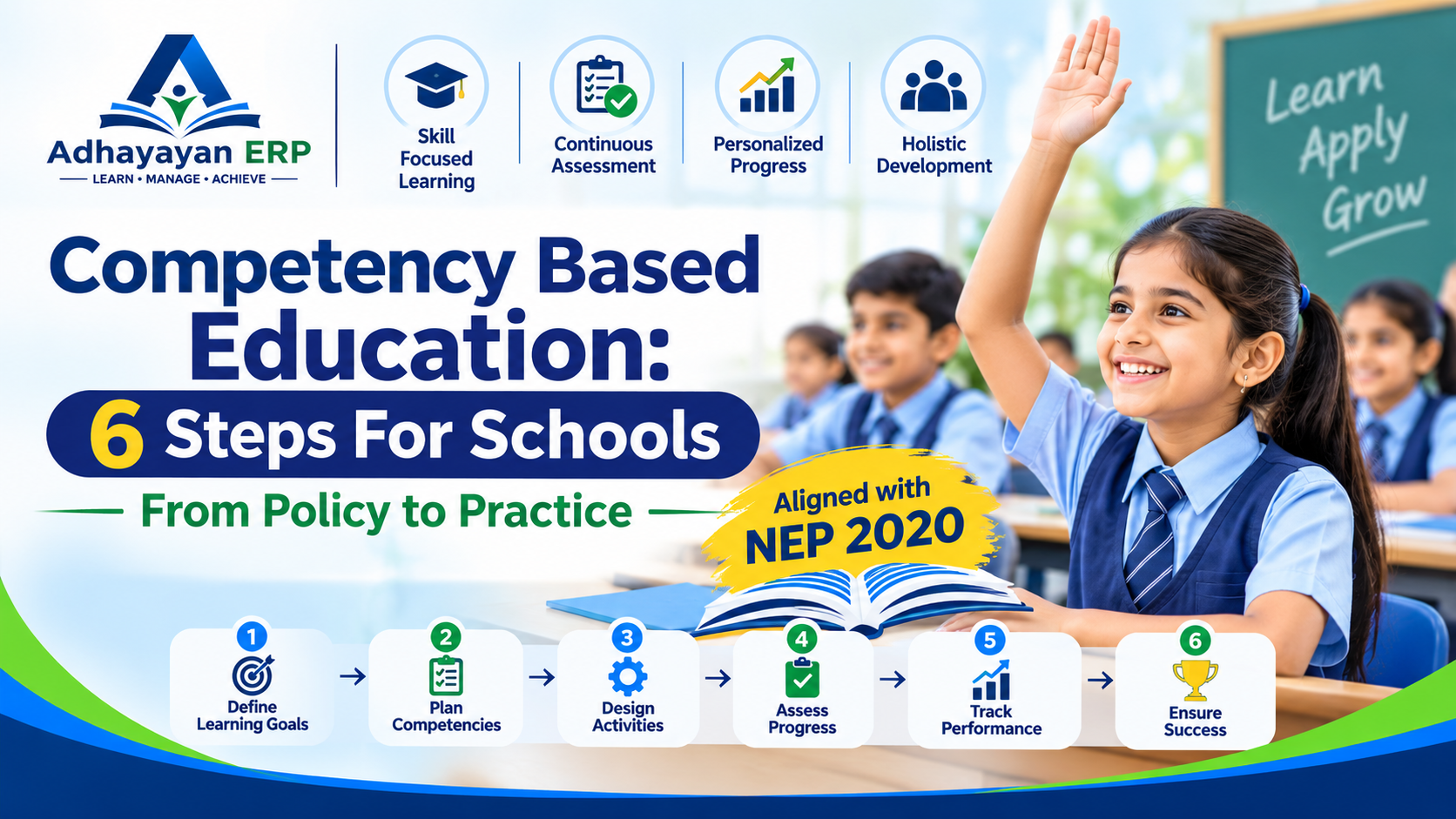
Start with one subject in one grade. Write 4 to 6 competencies, assess them every few weeks and review results monthly. A school can test competency based education this way before changing every report card.
1. Choose one subject and one grade for a single term.
2. Write 4 to 6 competencies in plain language that parents can read.
3. Build a rubric with 4 levels for each competency.
4. Plan 3 or more pieces of evidence per competency, mixing quizzes, tasks and oral checks.
5. Record every result in one shared system in the same week it happens.
6. Review the data monthly, regroup students and send parents a short progress note.
Expect a slow first month. Teachers need time to write rubrics and learn the recording routine, so protect a short weekly slot for it. Most of the effort comes early, and the routine gets quicker once the first few rubrics exist.
After one term, compare engagement and result patterns with the previous term before you scale to other subjects.
Frequently Asked Questions
What is competency based learning in simple words?
It is learning where students move ahead after showing they can apply a skill. Teachers give feedback and extra practice until the student reaches the expected level.
Does competency based education mean no exams?
No. Exams stay, but they sit beside classwork, projects, oral tasks and portfolios, so competency based education uses several kinds of evidence instead of one end of term paper.
How is a competency based curriculum different from a syllabus?
A syllabus lists topics to cover. A competency based curriculum lists the abilities students should show, then links topics, activities and assessments to each ability.
How many competencies should a teacher track per subject?
Start with 4 to 6 per term, so each skill can be checked several times and reporting stays manageable. Add more only when your records and parent reports can keep up.
Can a school ERP record competency scores?
A school ERP stores marks, remarks and reports in one place, so teachers can log evidence consistently. Ask the vendor how competency labels map to its exam and report modules during a demo.
How much does Adhayayan ERP cost for a school?
The website lists plans at ₹20, ₹40 and ₹60 per student per month. Final pricing depends on student strength, staff count, selected modules and prepaid or postpaid plans.
Where Do You Go From Here?
Pick one grade, write your first set of skills and book a free demo with the Adhayayan ERP team to see how exams and reports can hold that evidence. Starting competency based education with clean records saves months of rework later.
Serving Bengaluru, Karnataka.